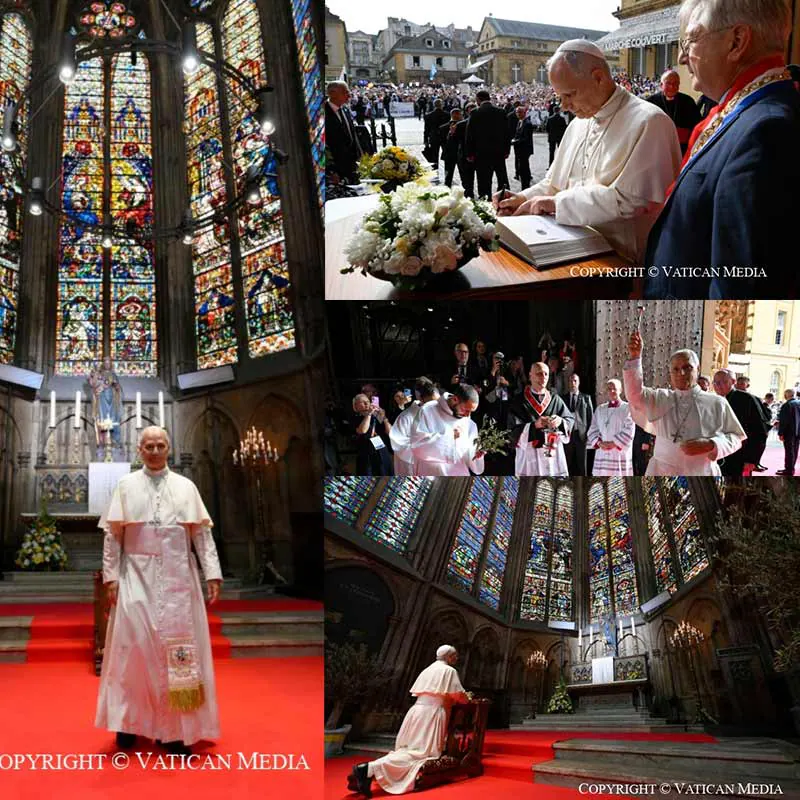
Pope Leo concluded his trip to France with a solemn Eucharistic celebration at Saint Stephen’s Cathedral in Metz on September 28, 2026. The region, known for its complex history of border shifts and conflict, provided a poignant backdrop for the Pope's message. He called on the faithful to build a future rooted in forgiveness, charity, and moral responsibility, drawing upon the biblical vision of the prophet Isaiah to outline a spiritual roadmap for peace.
The Pope reflected on Isaiah’s imagery of the desert, the garden, and the house, emphasizing the importance of human effort in building a harmonious society. He noted that while nature can foster simplicity and beauty, creating a home requires active labour, skill, and shared commitment. This, he argued, is essential for achieving true peace, which is not merely a passive gift but a direct responsibility requiring daily charity and mutual support.
Addressing global tensions, the Holy Father urged believers to reject retaliation and violence in favour of Gospel-inspired mercy and magnanimity. He challenged the notion that vengeance signals strength, citing the historic Moselle region as proof that true power lies in the courage to break chains of resentment and seek reconciliation. The Pope's words were a direct call to action for the faithful to strive for peace and understanding.
The Pope highlighted Europe’s foundational moral and spiritual heritage, which he argued precedes its economic and political frameworks. He cited the contributions of monasticism, local figures like Saint Chrodegang, and Saint John Paul II, recalling core principles such as the primacy of human life, individual freedom, support for the poor, protection of the family, and welcoming the stranger. These values, he urged, should guide the local Church of Metz.
Saint Stephen’s Cathedral, known as the “Lanterne du Bon Dieu” for its vast expanse of stained-glass windows, served as a powerful metaphor for unity. The Pope praised the integration of works by the renowned Jewish painter Marc Chagall alongside traditional biblical depictions, describing the cathedral as a symbol of ecumenism and interreligious dialogue. This iconic landmark embodies the harmony of differences that the Pope advocated for.
The Pope expressed his wish for the Church in Metz to remain a beacon of hope for France, Europe, and the wider world. He emphasized that Europe’s future depends not on enforced uniformity, but on a harmony of differences where past wounds become avenues for light. This message of hope and unity concluded the Pope's pastoral visit to France.
The Southern Cross, the publication that reported on the Pope's visit, relies on the support of its readers to continue bringing the Good News to those in need. The Pope's message of forgiveness, charity, and moral responsibility resonated deeply with the congregation in Metz, and his call to action will continue to inspire the faithful in Europe and beyond.
Key points
- Pope Leo urges the faithful to build a future rooted in forgiveness, charity, and moral responsibility.
- The Pope highlights Europe’s foundational moral and spiritual heritage as a guide for the local Church of Metz.
- Saint Stephen’s Cathedral in Metz serves as a symbol of ecumenism and interreligious dialogue.