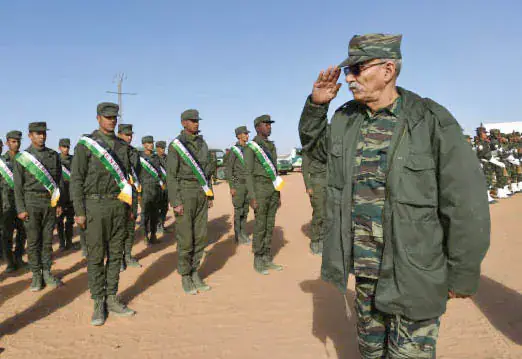
The Polisario Front has declared a general mobilization of the Sahrawi people in response to increased military activities by Morocco in the Western Sahara region. This decision was made during an emergency session of the Front's National Secretariat, led by Brahim Ghali, Secretary-General of the Polisario Front and President of the Sahrawi Arab Democratic Republic (SADR). The mobilization aims to counter Moroccan actions deemed a threat to regional stability.
The Moroccan military escalation includes activities along the so-called "wall of shame" and in disputed areas. The Sahrawi authorities have denounced Morocco's "expansionist policy and systematic obstruction" of international peace efforts. In response, the Polisario Front has called on all Sahrawis to be prepared and mobilized to defend national achievements and counter Moroccan maneuvers.
The general mobilization is also a reaction to Morocco's strategy following the Russian veto on a US-sponsored resolution at the UN Security Council, which led to the non-renewal of the MINURSO mandate. Morocco has been seeking to redefine the situation on the ground through its actions, with the support of its allies, including Israel. A delegation of Israeli military officials visited Morocco recently, marking a deepening of military cooperation between the two countries.
The Israeli-Moroccan military cooperation includes joint exercises and the establishment of a permanent Israeli defense attaché office in Rabat. This cooperation has raised concerns in the region, particularly given the context of the Western Sahara conflict. Morocco's King Mohammed VI has stated that his country is committed to respecting the ceasefire with the Polisario Front, while also pursuing development projects in the southern provinces.
Despite Morocco's claims of commitment to the ceasefire, its military has conducted drone strikes in the region, targeting several vehicles and resulting in casualties. A Mauritanian livestock truck was reportedly hit, killing two people. These actions have contributed to the escalation of tensions in the region, prompting the Polisario Front's call for general mobilization.
The UN General Assembly held an emergency session to discuss Russia's veto on the US-sponsored resolution, which blocked the renewal of the MINURSO mandate. The session, convened under General Assembly Resolution 76/262, allows for automatic debate within ten working days of a permanent member exercising its veto power. Over 30 countries participated in the debate, with many more expected to speak in the coming days.
The international community remains engaged on the Western Sahara issue, with many countries and regional groups expressing their concerns. The African, Latin American, and Asian countries, including Algeria, Namibia, and South Africa, have shown interest in the matter. The Polisario Front's general mobilization has been endorsed by many, who see it as a necessary response to Moroccan aggression and a bid to protect Sahrawi rights.
Key points
- The Polisario Front has declared a general mobilization of the Sahrawi people in response to Moroccan military escalation in Western Sahara.
- Morocco's military activities have been denounced by the Sahrawi authorities as an "expansionist policy and systematic obstruction" of international peace efforts.
- The international community remains engaged on the Western Sahara issue, with many countries and regional groups expressing their concerns.
Reporting sources
- POUR FAIRE FACE À L’ESCALADE DE L’OCCUPANT MAROCAIN : Le Polisario décrète la mobilisation générale · lecourrier-dalgerie.com