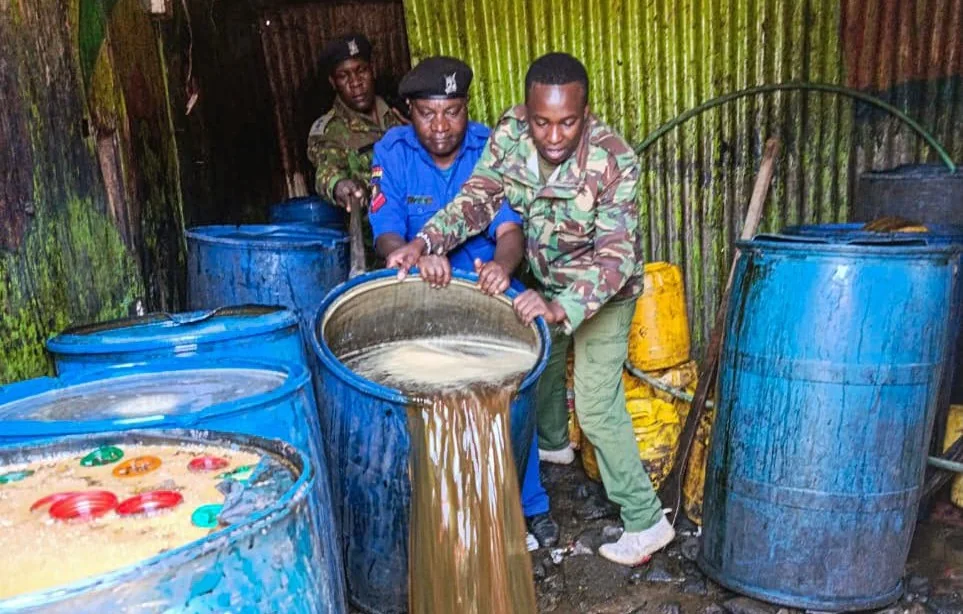
Police officers from Kahawa West Police Station in Nairobi, Kenya, conducted an operation on September 25, 2026, destroying 2,720 litres of illicit brews. The destroyed brews included 2,600 litres of kangara and 120 litres of chang'aa. The operation targeted premises suspected of being used to manufacture illicit alcoholic drinks and sell drugs in Soweto and Saa Mbaya.
The National Police Service (NPS) stated that the operation was part of their continued efforts to deal with the production and sale of alcohol outside the required legal controls. The NPS also dismantled and destroyed equipment believed to have been used to make the illegal alcoholic drinks. This crackdown aims to disrupt illegal alcohol production and address activities linked to other forms of crime.
The Kahawa West operation is part of a broader effort to enforce the law and protect residents from the risks associated with unregulated alcohol and drug distribution. According to the NPS, the operation also serves to deter criminal activity and reinforce the Service's commitment to maintaining law and order and protecting members of the public.
The 2022 National Survey on the Status of Drugs and Substance Use conducted by the National Authority for the Campaign Against Alcohol and Drug Abuse (NACADA) reported that 19.3 per cent of Kenyans aged between 15 and 65 had consumed alcohol in the year before the survey. This translates to approximately 5.2 million people nationally, with Nairobi recording a higher rate of 23.7 per cent.
The survey further showed that alcohol use was higher among some age groups in Nairobi, with 28.8 per cent of people aged between 25 and 35 reporting alcohol consumption during the previous year. Despite the continued use of alcohol, NACADA data showed that past-month alcohol consumption among Kenyans aged 15 to 65 fell from 14.2 per cent in 2007 to 11.8 per cent in 2022.
Under Kenya's Alcoholic Drinks Control Act, the manufacture, production, sale or distribution of alcoholic drinks requires the relevant licence. The law also provides for action against alcoholic drinks that are made or held in breach of prescribed standards. Authorities have continued to carry out operations against illegal breweries in different parts of Kenya as part of efforts to enforce the law.
The government has raised concerns over the illegal alcohol trade, linking the issue to public health and security concerns and calling for cooperation between enforcement agencies and those involved in the legitimate alcohol industry. Police have asked residents to report suspected illegal activities and share information with law enforcement agencies through established channels to assist in keeping their communities safe.
Key points
- The operation resulted in the destruction of 2,720 litres of illicit brews, including 2,600 litres of kangara and 120 litres of chang'aa.
- The crackdown aims to disrupt illegal alcohol production and address activities linked to other forms of crime.
- The National Police Service remains focused on safeguarding communities through sustained enforcement against activities that facilitate crime.