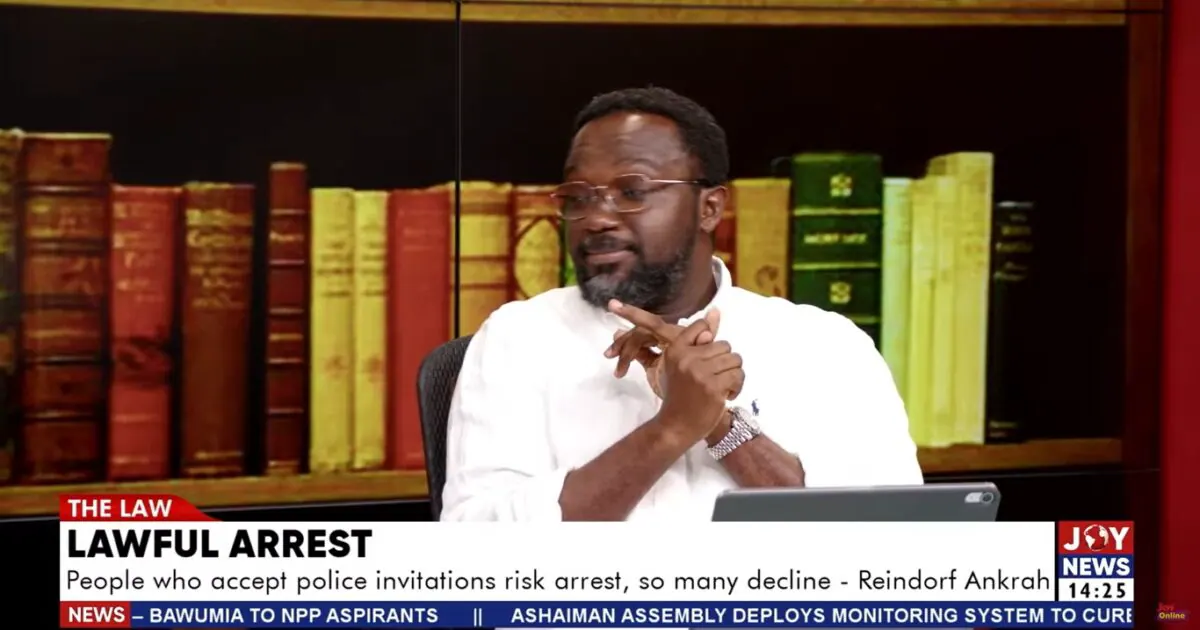
Reindorf Twumasi Ankrah, Acting Chief Executive Officer of the Ghana Integrated Aluminium Development Corporation (GIADEC), has expressed concerns over law enforcement agencies' practice of blurring the distinction between inviting citizens to assist investigations and placing them under arrest. Speaking on JoyNews, he stated that this practice has created apprehension among people who might otherwise be willing to assist investigations.
According to Mr. Twumasi Ankrah, an invitation could be a request for information or documents to help investigators establish the facts, without the person being treated as a suspect. However, he noted that some people honoured such requests only to discover that they were no longer free to leave. This has led to uncertainty among citizens about what to expect when invited by the police.
Mr. Twumasi Ankrah argued that once a person's freedom to leave was restricted, law enforcement officers must recognise the change in circumstances and take steps to safeguard the person's constitutional rights. He stated that the police are required by law to take certain steps to ensure that a person's constitutional rights are safeguarded, but mostly, the police blur the line between invitations and arrests.
The legal practitioner acknowledged that inviting someone to assist an investigation was generally a prudent approach, particularly when investigators had yet to determine the person's role in a case. He said the difficulty arose when invitations routinely resulted in arrests, leaving citizens uncertain about what to expect. This has prompted some people to decline invitations and wait for law enforcement agencies to exercise their powers of arrest.
Mr. Twumasi Ankrah advised people attending police invitations to seek legal assistance, explaining that their status could change during questioning. He stressed that legal representation could help individuals understand their position in an investigation and assert their rights if an invitation developed into an arrest. This would help pre-empt anything that may happen which was not within their contemplation.
The uncertainty has prompted some people to decline invitations and wait for law enforcement agencies to exercise their powers of arrest. Citizens are consequently trying to balance their willingness to assist investigators with the need to protect their liberty. Mr. Twumasi Ankrah added that there is a genuine fear that when people go to the police, there is a likelihood they won't come back home.
Mr. Twumasi Ankrah's comments were made on October 4, 2026, during an interview with Samson Lardy on The Law on JoyNews. His concerns highlight the need for law enforcement agencies to be transparent and clear in their interactions with citizens, ensuring that their constitutional rights are respected and protected throughout the investigation process.
Key points
- Reindorf Twumasi Ankrah criticizes police for blurring the line between invitations and arrests.
- The practice has created apprehension among people who might otherwise be willing to assist investigations.
- Mr. Twumasi Ankrah advises people attending police invitations to seek legal assistance.