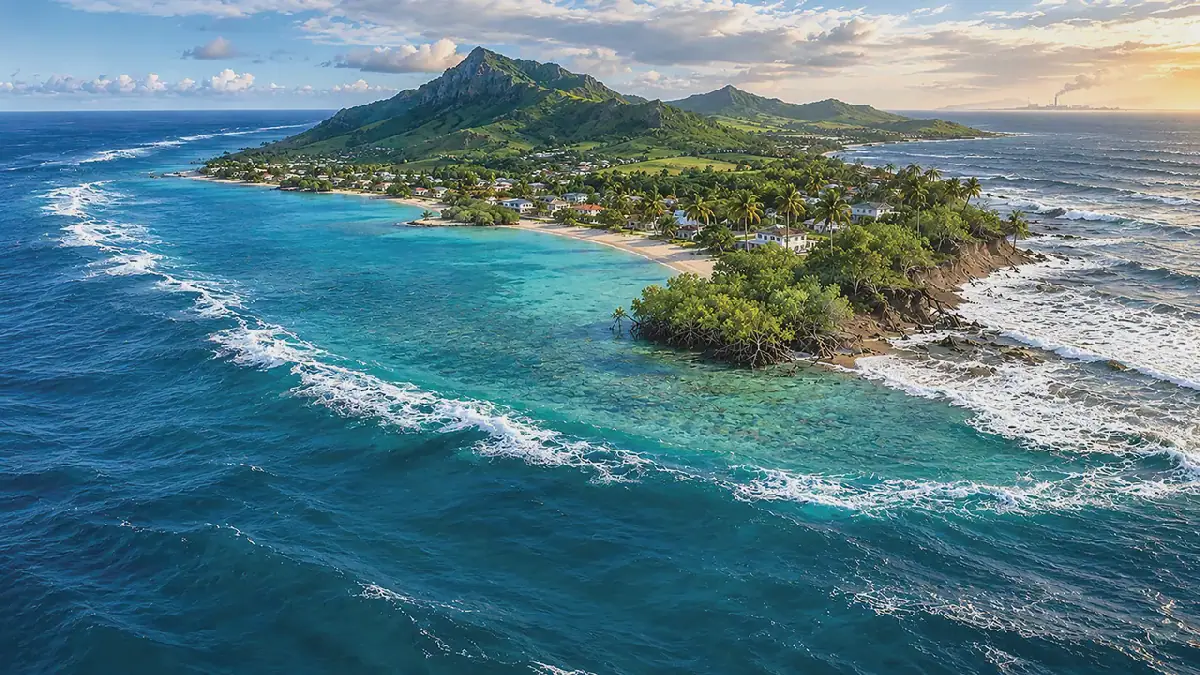
The ocean plays a crucial role in regulating the climate, absorbing 30% of carbon dioxide emissions from human activities and 90% of excess heat. This absorption has significant implications, with the ocean taking in an average of 3.2 billion tonnes of carbon per year between 2015 and 2024. As a result, the ocean's capacity to act as a carbon sink and heat regulator is vital for maintaining a stable climate. However, this role is being threatened due to rising temperatures.
Small island nations, including those in the Pacific and Indian Oceans, are among the most vulnerable to the impacts of climate change. These countries face significant challenges, with 70 million inhabitants in small island developing states contributing less than 1% to global greenhouse gas emissions. Despite this, they experience severe effects, including a 0.15 to 0.25°C warming of ocean surface temperatures per decade in certain regions and a 11mm per year rise in sea levels in the Pacific tropical western region between 1993 and 2014.
Mauritius, an island nation in the Indian Ocean, is also experiencing the impacts of climate change. The country's considerable maritime territory, with a 1.94 million km² exclusive economic zone, is under threat. Rising temperatures and sea levels are projected to have devastating effects, with estimated losses of up to 9% of annual GDP due to coastal disasters. Furthermore, Mauritius has seen significant losses in working hours due to heat, with over 4.4 billion hours lost in 2023.
The impact of climate change on coastal ecosystems is a pressing concern for Mauritius and other island nations. For example, the Seychelles has 159,920 hectares of marine meadows that store 18.9 million tonnes of organic carbon, equivalent to 69 million tonnes of CO2. In contrast, Fiji has lost 1,135 hectares of mangroves between 2001 and 2018, largely due to tropical cyclones. The Dominican Republic has also seen significant losses in mangrove carbon stocks due to conversion to shrimp farming.
The financing gap for climate adaptation and mitigation efforts is a significant challenge. In 2023, $1,800 billion was allocated to climate mitigation, while only $66.59 billion was dedicated to adaptation efforts. The estimated annual need for adaptation financing in developing countries is $310 billion. Moreover, $2,000 billion is required between 2030 and 2050 to tap into the potential of ocean-based technologies.
The economic implications of climate change for island nations like Mauritius are substantial. The country's position as a carbon sink, with a net annual carbon position of +4.03 million tonnes, is notable. However, the loss of coastal ecosystems and the impacts of climate-related disasters pose significant threats to the economy. In some small island nations, losses related to coastal disasters can reach up to 9% of annual GDP.
As the world grapples with the challenges of climate change, the importance of ocean-based solutions and climate financing cannot be overstated. With the ocean facing increasing pressure, it is essential to address the financing gap and develop strategies to support vulnerable nations like Mauritius. The development of ocean-based technologies and the preservation of coastal ecosystems are critical for mitigating the impacts of climate change and ensuring a sustainable future.
Key points
- Ocean absorbs 30% of human CO2 emissions and 90% of excess heat
- Small island nations face significant climate change impacts despite low emissions
- Financing gap for climate adaptation and mitigation efforts poses significant challenges
Reporting sources
- Océan : un allié du climat sous pression · Le Défi Plus