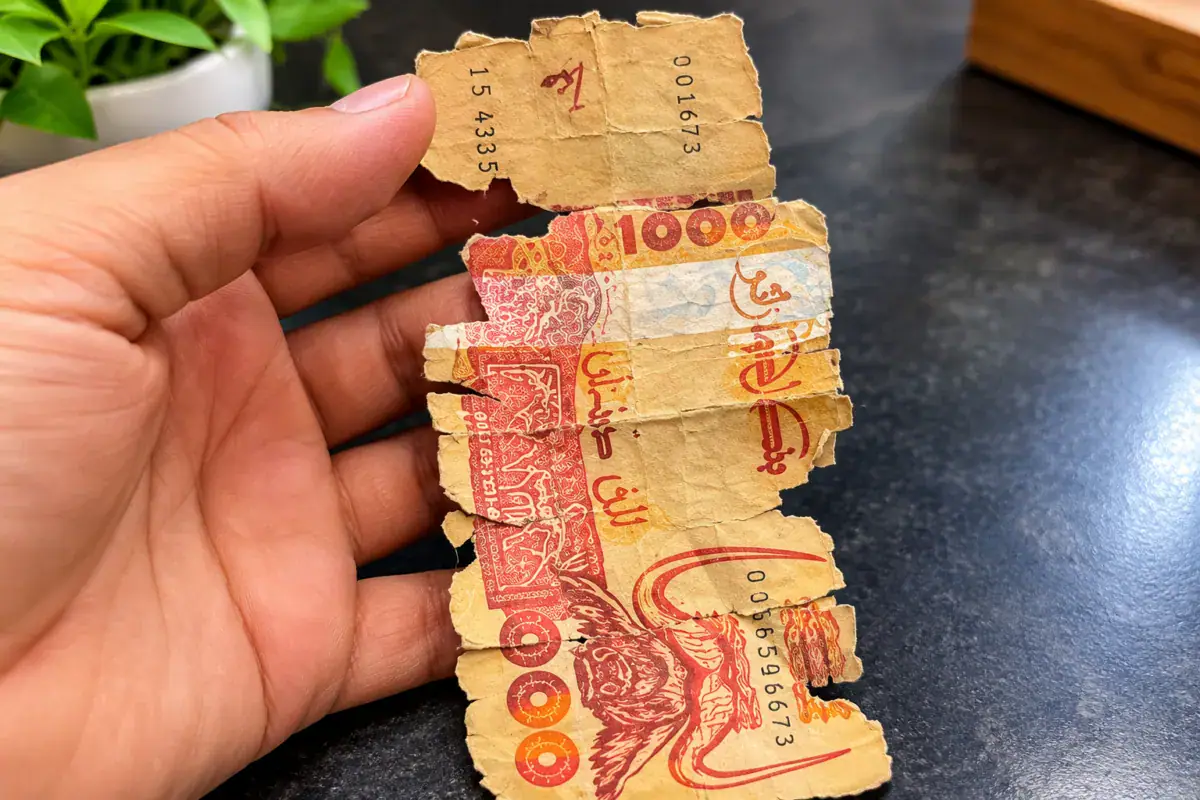
The Banque d'Algérie has established guidelines for exchanging damaged banknotes, which can be worn, torn, or damaged by water or fire. According to the institution, certain banknotes can be exchanged provided they meet specific criteria related to their condition and visible identification elements. The exchange process varies depending on the extent of the damage, and in some cases, an expert assessment may be required in Algiers.
To initiate the exchange process, individuals must visit a Banque d'Algérie branch, not their personal bank, and fill out a request form. The form requires the individual's identity, address, and phone number, as well as details about the damaged banknotes, including their number, value, and cause of damage. A valid piece of identification must be presented, and in cases of fire or flood damage, a police report from the day of the incident is also required.
The Banque d'Algérie has identified two cases where damaged banknotes can be exchanged immediately at a branch office. Firstly, if the banknote still displays all its recognizable signs, it is considered identifiable and can be redeemed on the spot. Secondly, if the banknote is damaged but still intact, or if at least two-thirds of its surface remains, with one of its lateral alphanumeric identifiers intact and legible, it can also be exchanged immediately.
In cases where the banknote's characteristics are incomplete or its condition makes it unusable, the branch will reconstitute the banknote and send it to the Caisse générale de la Banque d'Algérie for examination. A half-banknote can be accepted if it retains a complete lateral alphanumeric identifier. The Caisse générale will then decide on the reimbursement or devaluation of the banknote.
According to the Ministry of Finance, damaged banknotes that cannot be exchanged at a branch office are handled by the Caisse générale, which makes the final decision on reimbursement or devaluation. The Ministry cited Law 23-09 on currency and credit, as well as the recognition elements of banknotes, which are categorized into three levels, with the last one being confidential.
The Banque d'Algérie has a network of 48 branches across the country, and individuals can visit any of these branches to initiate the exchange process. The institution treats worn and mutilated banknotes under the same category and encourages individuals to exchange their damaged banknotes rather than keeping them out of circulation.
The exchange process for damaged banknotes is designed to help individuals recover the value of their damaged currency. By following the guidelines set by the Banque d'Algérie, individuals can ensure that their damaged banknotes are handled efficiently and effectively. The institution's efforts aim to maintain the integrity of the country's currency and promote financial stability.
Key points
- The Banque d'Algérie allows exchange of damaged banknotes under specific conditions related to their state and visible identification elements.