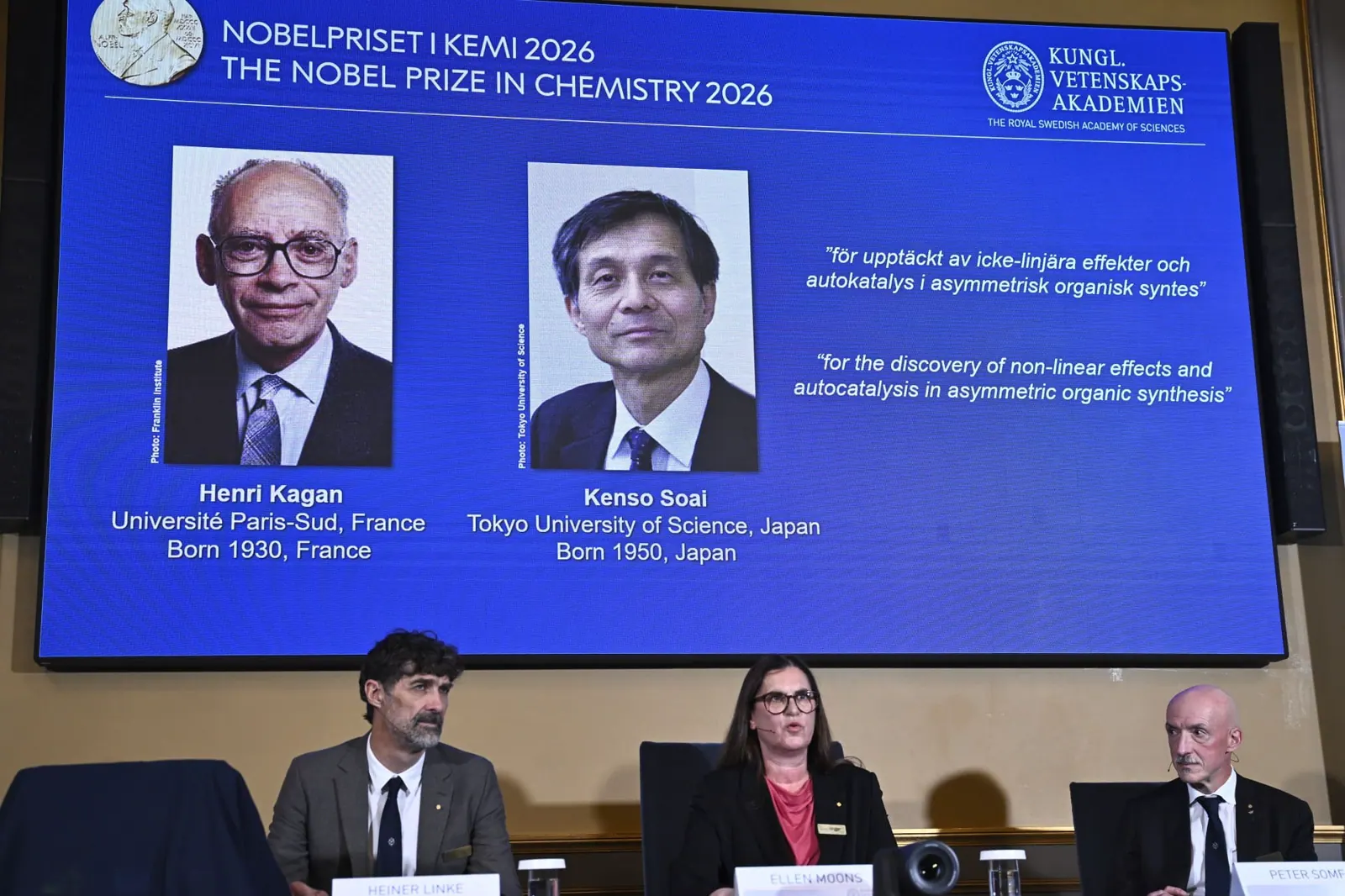
The Nobel Prize in Chemistry for 2026 has been awarded to Henri B. Kagan, a researcher at the University of Paris, and Kenso Soai, from the University of Tokyo. Their groundbreaking discovery enables chemists to synthesize molecules that exist as mirror images of each other with greater efficiency. This breakthrough has significant implications for the pharmaceutical industry, allowing for the production of targeted medications with reduced side effects.
According to Paula Branco, a chemistry professor at the Faculty of Sciences and Technology of the New University of Lisbon, the work of Kagan and Soai is "very pioneering" and contributes to the development of asymmetric synthesis in the pharmaceutical industry. Asymmetric synthesis is crucial in producing medications that interact with specific biological targets, reducing the risk of adverse reactions.
The Nobel Prize in Chemistry was awarded to Kagan and Soai for their discovery of non-linear effects and autocatalysis in asymmetric organic synthesis. This breakthrough enables chemists to produce molecules with a specific structure, which is essential for the development of effective medications. The discovery has far-reaching implications for the pharmaceutical industry, allowing for the production of targeted treatments with improved efficacy.
Paula Branco highlights the significance of this discovery, stating that it enables chemists to synthesize specific compounds with greater precision. This is particularly important in the pharmaceutical industry, where the production of targeted medications can reduce the risk of side effects. The discovery also has implications for the development of new medications, as it enables chemists to produce complex molecules with greater efficiency.
The award-winning research focused on the development of ligands that can catalyze the formation of specific molecules. These ligands play a crucial role in asymmetric synthesis, enabling chemists to produce molecules with a specific structure. The discovery of non-linear effects and autocatalysis has opened up new avenues for research in asymmetric synthesis, with significant implications for the pharmaceutical industry.
According to the Nobel Prize Committee, Kagan and Soai's discovery has resolved a long-standing mystery in chemistry. Their research has paved the way for the development of new medications and has significant implications for the pharmaceutical industry. The Nobel Prize in Chemistry recognizes the importance of their discovery, which has the potential to improve the lives of millions of people worldwide.
The recognition of Kagan and Soai's work by the Nobel Prize Committee underscores the significance of their discovery. As researchers continue to build on their findings, the impact of their work will be felt for years to come. The development of targeted medications with improved efficacy and reduced side effects is a major step forward in the field of medicine.
Key points
- The Nobel Prize in Chemistry was awarded to Henri B. Kagan and Kenso Soai for their discovery of non-linear effects and autocatalysis in asymmetric organic synthesis.
- The discovery enables chemists to produce molecules with a specific structure, which is essential for the development of effective medications.
- The research has significant implications for the pharmaceutical industry, allowing for the production of targeted treatments with improved efficacy.