The Muslim Rights Concern (MURIC) has called on Nigerian law schools in Abuja, Lagos, and Yenagoa to allow female Muslim students wearing hijab to sit for the final Bar examination scheduled to begin on October 31, 2026. MURIC's Founder and Executive Director, Professor Ishaq Akintola, condemned an alleged directive barring hijab-wearing students from entering examination halls, citing unfair penalization of innocent Muslim candidates over an incident involving a student found with an earpod during an examination.
The controversy arises as candidates prepare for the Nigerian Law School's 2026 Bar Part II Final Examination, set to run from October 31 to November 7, across seven campuses in Abuja, Lagos, Enugu, Kano, Yola, Yenagoa, and Port Harcourt. The examination timetable provides context for the urgency of MURIC's appeal, particularly as the first examination is scheduled for Saturday, amid concerns over whether hijab-wearing candidates would be admitted to their examination halls.
According to MURIC, the alleged directive was prompted by an incident in which a female Muslim student wearing hijab was found with an earpod during an examination. Professor Akintola argued that disciplinary measures should target individuals found guilty of misconduct rather than an entire group of students, emphasizing that hijab is not the offender and should not be banned from the examination hall.
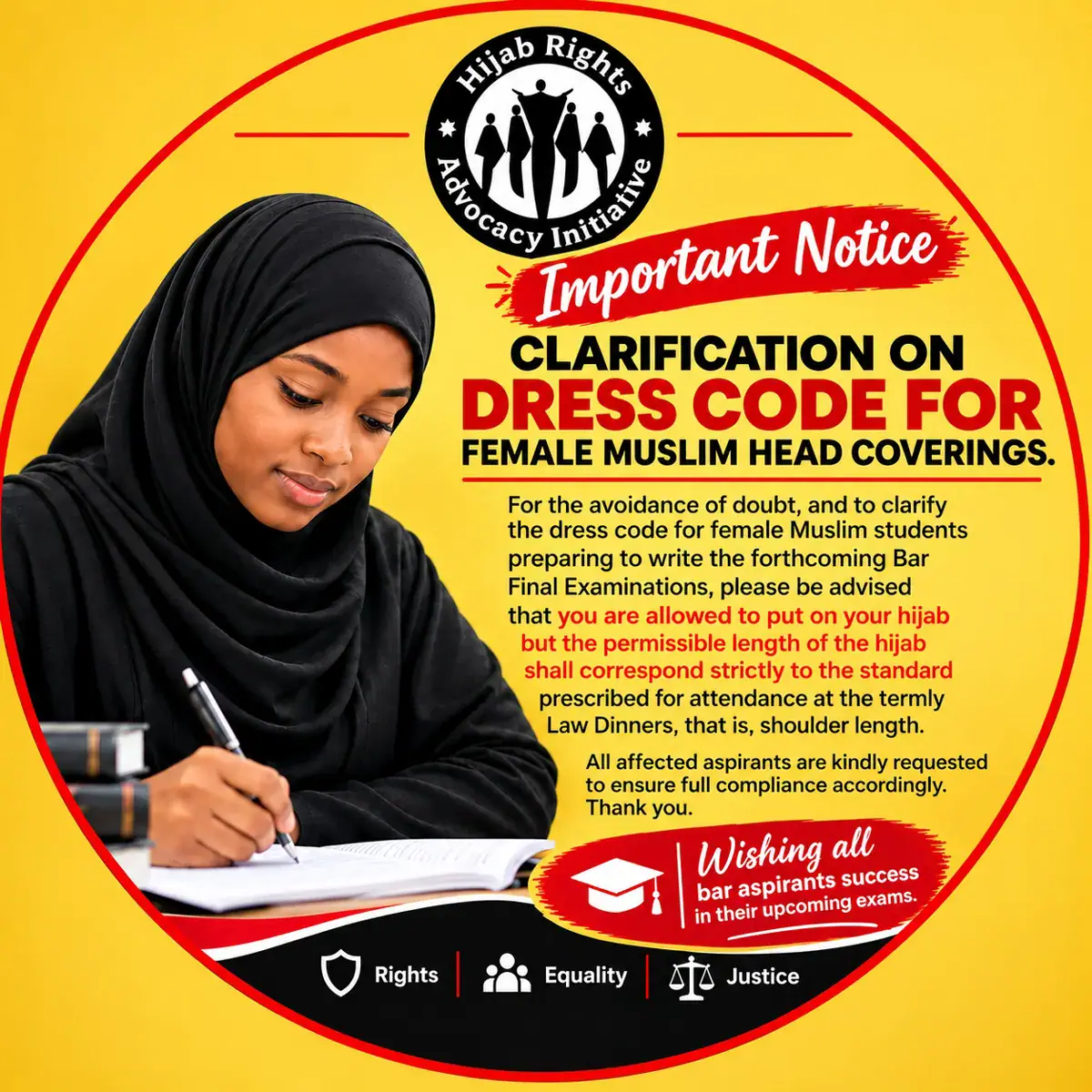
The Hijab Rights Advocacy Initiative (HRAI) has separately issued a clarification on the dress code, stating that female Muslim candidates are permitted to wear hijab, provided its length does not extend beyond the shoulders. HRAI's Director, Hajia Mutiat Orolu-Balogun, signed the notice, which aims to clarify the dress code for female Muslim students preparing for the Bar final examination.
MURIC recalled the case of Amasa Firdaus, whose refusal to remove her hijab during the 2017 Call to Bar proceedings sparked a nationwide debate over religious freedom and dress codes in the legal profession. Akintola argued that preventing Muslim women from wearing hijab could violate their fundamental rights and cause psychological distress.
The organisation cited Article 33 of the Fourth Geneva Convention, which prohibits collective penalties against protected persons for offences they did not personally commit. Akintola argued that the principle reinforced MURIC's objection to penalizing all hijab-wearing candidates over the alleged misconduct of one student, emphasizing that individual misconduct should not justify restrictions affecting an entire category of students.
MURIC urged the Nigerian Law School authorities to reconsider the alleged directive and ensure that all eligible candidates can participate in the examination without discrimination. The organisation also referred to unverified reports that the Lagos campus had agreed to allow hijab-wearing candidates to write the examination, urging the authorities in Abuja and Yenagoa to adopt a similar position.
Key points
- MURIC and HRAI urge Nigerian law schools to permit female Muslim students wearing hijab to sit for final Bar examination
- Alleged directive barring hijab-wearing students from entering examination halls sparks controversy
- HRAI clarifies permissible hijab length for female Muslim candidates as not extending beyond the shoulders