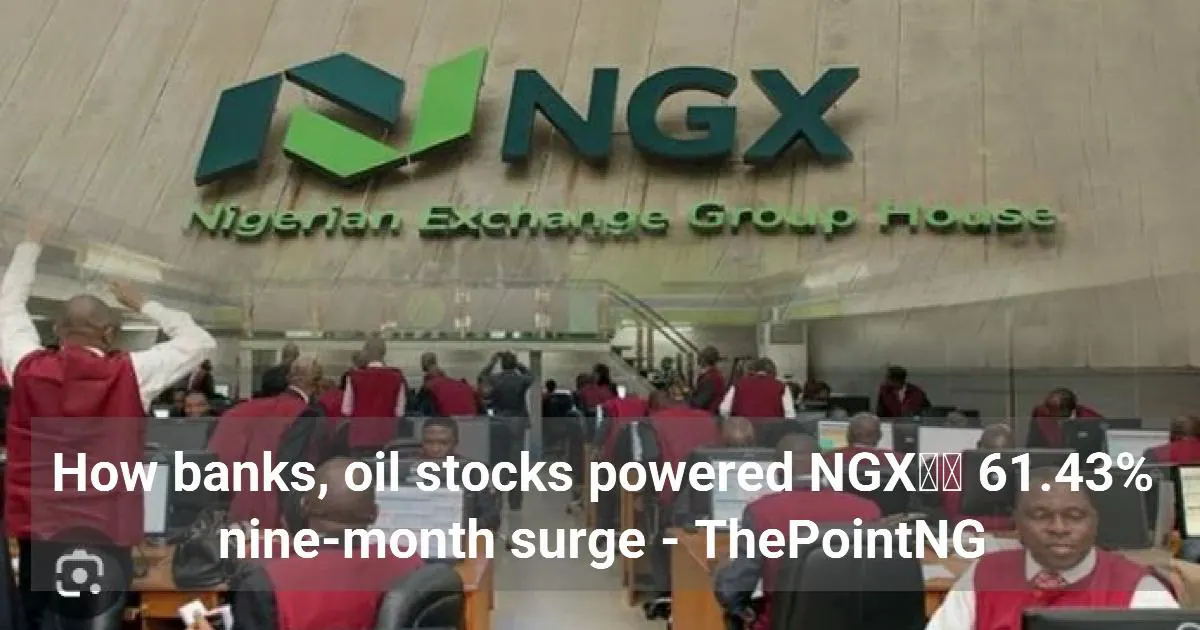
Nigeria's equities market delivered a strong performance in the first nine months of 2026, with the benchmark Nigerian Exchange Limited All-Share Index rising by 61.43%. The rally created an estimated N63.72 trillion increase in market capitalization, pushing the value of listed equities from N99.38 trillion at the beginning of January to N163.10 trillion by the end of September. The All-Share Index also climbed from 155,613.03 points to 251,211.67 points, reflecting a gain of 95,598.64 points.
The banking sector was a major driver of the rally, with the Central Bank of Nigeria's recapitalization program triggering a wave of capital raising and renewed investor interest in financial stocks. The regulatory requirement prompted banks to turn to the capital market to strengthen their balance sheets and raise fresh funds, generating significant activity across the equities market. This heightened investor expectations that better-capitalized banks would have greater capacity to expand lending, absorb economic shocks, and sustain dividend payments.
The oil and gas sector also provided a significant pillar of the rally, driven by higher international crude oil prices. The stronger crude price environment encouraged investors to increase their exposure to energy stocks on expectations of higher revenues and improved profitability for companies with significant upstream operations. As a result, oil and gas stocks emerged among the strongest-performing segments of the market during the period.
The performance of banking and energy stocks was complemented by stronger corporate earnings across several listed companies. Investors responded positively to improved financial results and earnings expectations, reinforcing buying interest even as the market experienced bouts of profit-taking. The combination of stronger bank capitalization, higher oil prices, and improved corporate performance helped the market absorb several periods of correction during the nine-month period.
Despite the strong performance, the market experienced corrections in June and August, when investors moved to lock in profits following substantial gains recorded earlier in the year. Market capitalization fell by about N13.29 trillion in June, while August recorded a decline of approximately N587 billion. However, these corrections did not reverse the broader upward trajectory, with market analysts viewing the sell-offs as profit-taking rather than evidence of a fundamental deterioration in the equities market.
The rally occurred against a challenging macroeconomic backdrop, with inflationary pressures remaining elevated, interest rates high, foreign exchange uncertainties persisting, and geopolitical tensions affecting global financial markets. Despite these headwinds, domestic investor confidence remained relatively strong, with investors continuing to identify opportunities in sectors benefiting from structural reforms and improved earnings prospects.
Going forward, the sustainability of the rally will depend on whether companies can translate higher valuations and improved access to capital into stronger earnings. For banks, attention will shift from the capital-raising phase to how effectively the additional capital is deployed to expand lending, grow income, and improve shareholder returns. For oil companies, crude prices, production levels, investment in upstream assets, and the broader operating environment will be critical in determining future performance.
Key points
- The Nigerian equities market rose 61.43% in the first nine months of 2026.
- The banking sector was a major driver of the rally, driven by the Central Bank of Nigeria's recapitalization program.
- The sustainability of the rally will depend on whether companies can translate higher valuations and improved access to capital into stronger earnings.