Nigeria's broad money supply, also known as M3, has reached an all-time high of N139.38 trillion in August 2026, increasing by 12.4% Year-to-Date (YtD). This growth is notable given the Central Bank of Nigeria's (CBN) ongoing monetary tightening efforts aimed at controlling inflation and stabilizing the Naira. M3 is a comprehensive measure of money in circulation, including cash used in everyday transactions, large-scale deposits, and financial assets that influence lending, investment, and inflation.
The CBN's monetary tightening stance has been firm, with the Monetary Policy Rate (MPR) held at 26.50% at its July 2026 meeting. However, in a recent move to tackle inflation, the MPR was cut to 23%. Despite this, the money supply has continued to rise, increasing by 16.5% year-on-year (YoY) from N119.69 trillion in August 2025. On a month-on-month basis, the figure climbed by 0.43% from N138.78 trillion recorded in July 2026.
According to the CBN's money and credit statistics, the M3 has been steadily increasing, from N123.95 trillion in January 2026 to N124.99 trillion in April 2026, N129.21 trillion in May 2026, and N133.25 trillion in June 2026. The August increase amounted to approximately N601.6 billion compared with the previous month. This growth indicates a significant expansion in the money supply, despite the CBN's efforts to reduce liquidity.
In a bid to counteract inflationary pressures and stabilize exchange rate fluctuations, the CBN withdrew N4.72 trillion from the financial system through Open Market Operations (OMO) auctions between August 26 and 27, 2026. Analysts noted that this move was part of broader efforts to reduce liquidity and cool rising consumer prices. The CBN's actions demonstrate its delicate balancing act in managing liquidity while maintaining FX stability and curbing inflation.
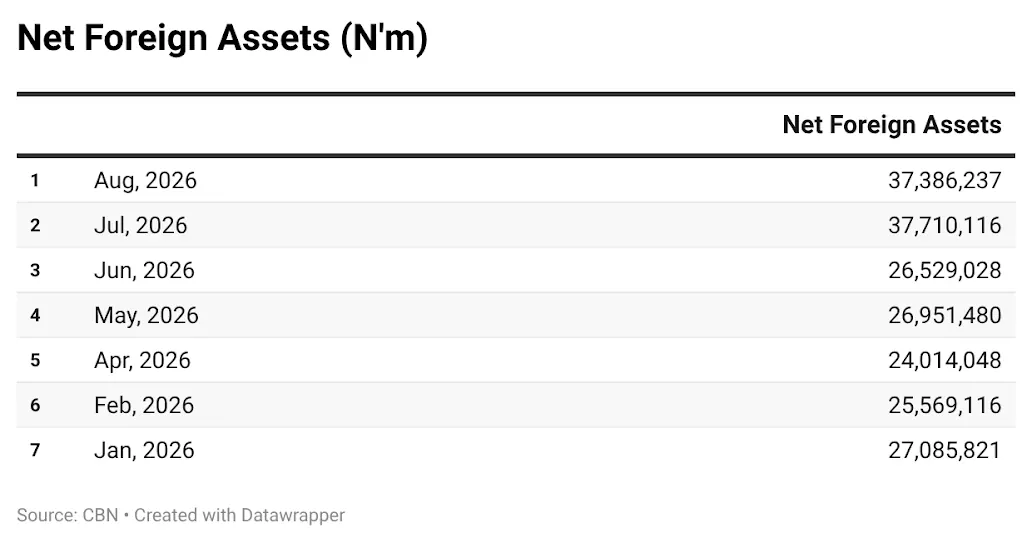
A closer look at the components of M3 reveals a notable shift in liquidity sources. In August 2026, the surge in money supply was driven largely by higher net foreign assets, which stood at N37.39 trillion, a 10.1% YoY drop from N41.59 trillion in August 2025. At the same time, net domestic assets increased significantly to N101.99 trillion in August 2026, up from N78.11 trillion in August 2025, a rise of 31% YoY.
Nigeria's money supply (M2), a narrower gauge of liquidity that excludes certain institutional holdings, also recorded a significant increase, appreciating to N139.37 trillion in August, about a 16.44% increase when compared to N119.68 trillion in August 2025. Narrow money (M1), which captures the most liquid assets such as currency in circulation and demand deposits, also increased, moving from N39.39 trillion in August 2025 to N43.26 trillion in August 2026, a growth of 9.8%.
The interplay between domestic and foreign asset movements illustrates the challenges faced by the CBN in managing the economy. The bank must balance injecting or mopping up liquidity while maintaining FX stability and curbing inflation. The continued growth in money supply, despite the CBN's tightening stance, highlights the complexities of monetary policy implementation in Nigeria.
Key points
- Nigeria's broad money supply (M3) reached a record high of N139.38 trillion in August 2026.
- The growth in money supply is notable despite the CBN's ongoing monetary tightening efforts.
- The CBN withdrew N4.72 trillion from the financial system through OMO auctions to reduce liquidity and curb inflation.