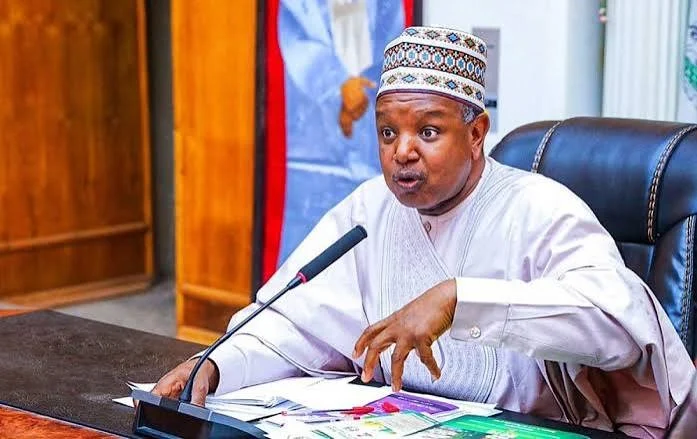
The Minister of Budget and Economic Planning, Senator Abubakar Bagudu, has stated that Nigeria has one of the smallest national budgets among the world's 10 most populous countries. This assertion was made during the Senate Press Corps Capacity-Building Workshop in Abuja, where he emphasized the need for a broader national conversation on revenue mobilisation. According to Bagudu, Nigeria's limited fiscal space, relative to its population and development needs, raises questions about whether the country's current level of public spending is adequate to achieve its development objectives.
Bagudu called for a fundamental re-evaluation of Nigeria's budget, questioning whether the country should continue with a budget that leaves its populace with one of the smallest budgets. He stressed that the country must consider how to expand its fiscal space to fund development and achieve its long-term economic aspirations. The minister's comments come as Nigeria seeks to build a more prosperous and inclusive economy, as outlined in President Bola Tinubu's Renewed Hope Agenda and the administration's ambition to build a $1tn economy.
The Minister of Budget and Economic Planning linked the issue of Nigeria's budget to the country's development needs, noting that Agenda 2050 provides a broader context for decisions on resource mobilisation and public investment. He emphasized that decisions on revenue, expenditure, and borrowing cannot be separated from public confidence, stressing that citizens' understanding and support are crucial to the ability of both the government and the National Assembly to take major fiscal decisions.
Bagudu also underscored the constitutional role of the National Assembly in the budget process, noting that the legislature has ultimate authority over the national budget within Nigeria's constitutional democracy. He urged greater public understanding of the relationship between the Executive and legislature in shaping the budget and encouraged the media to strengthen scrutiny through evidence-based reporting.
On alleged budget insertions, the minister cautioned against assuming that every unfamiliar provision is irregular, saying journalists should investigate the origin, purpose, and beneficiaries of specific provisions. He emphasized the importance of vigilance and encouraged the media and legislative oversight to remain vigilant. Bagudu also called for a balanced discussion on budget transparency, particularly where the disclosure of sensitive information could have implications for national security or strategic interests.
The minister urged journalists to remain rigorous in holding public institutions to account while ensuring that coverage of the national budget does not lose sight of Nigeria's broader development challenges. He asked, "How careful are we to ensure that, while insisting on holding public officials to account, we do not lose sight of the bigger picture?" Bagudu's comments come as the country's budget conversation continues, with an analysis published by PUNCH Online in August showing that the combined budgets of Nigeria's 36 states and the Federal Capital Territory rose by 47.5 per cent, from N27.22tn in 2025 to N40.14tn in 2026.
The Federal Government's 2026 budget stands at N68.32tn, significantly above the combined budgets of the 36 states and the FCT. Despite the increase, the proportion allocated to capital projects fell from 73.24 per cent in 2025 to 64.34 per cent in 2026. In nominal terms, however, capital expenditure increased from N19.94tn to N25.83tn during the period, indicating that the decline was in the share of overall spending rather than the absolute amount allocated to capital projects.
Key points
- Nigeria's budget is one of the smallest among the world's 10 most populous countries.
- The Minister of Budget and Economic Planning, Senator Abubakar Bagudu, called for a broader national conversation on revenue mobilisation.
- The country's 2026 budget stands at N68.32tn, significantly above the combined budgets of the 36 states and the FCT.