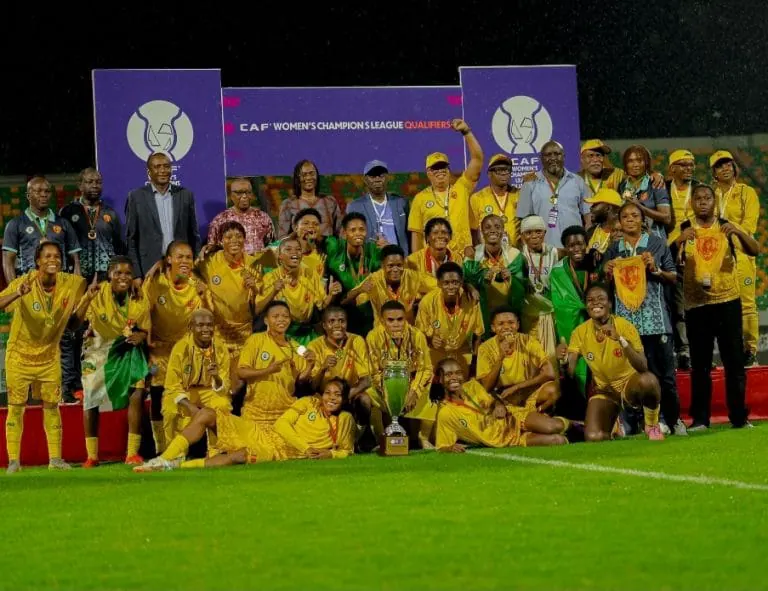
The Nigeria Football Federation (NFF) has appealed the Confederation of African Football's (CAF) decision to annul Edo Queens' victory over Ampem Darkoa Ladies in the WAFU-B final. The appeal was filed on behalf of Edo Queens, challenging the basis for overturning the result of a match that had already been concluded through a penalty shoot-out. CAF's ruling on Sunday, September 27, 2026, sparked controversy, with the NFF now seeking to reverse the decision.
The WAFU-B final between Edo Queens and Ampem Darkoa Ladies ended 2-2 after 90 minutes, with Edo Queens winning 4-1 in a penalty shoot-out. CAF initially recognised the result, but Ampem Darkoa Ladies protested, arguing that the competition regulations required the match to proceed into extra time before penalties. The CAF Committee upheld Ampem Darkoa's protest, citing Article 72.4 of the competition regulations, which requires two 15-minute periods of extra time in a drawn final.
The NFF argues that Edo Queens should not be punished for an error committed by the match officials, who proceeded directly to a penalty shoot-out after regulation time. The federation maintains that players and clubs have no authority to determine when or how long a match should last, and that responsibility for the application of the rules rests with the match officials. The NFF emphasises that Edo Queens merely followed the referee's instructions and should not be held responsible for the procedural error.
In its appeal, the NFF identified several grounds, including the absence of any finding of misconduct, manipulation, bad faith or regulatory breach against Edo Queens. The federation also argued that any remedy adopted should have a clear regulatory foundation and be proportionate to the established irregularity. The NFF further argued that resuming the match under conditions that could materially alter the competitive circumstances in which it was originally concluded would be unfair.
The NFF drew a distinction between CAF's authority to identify an irregularity and its authority to impose a particular remedy. The federation acknowledged that Article 4 of the applicable regulations gives the relevant Organising Committee responsibility for applying the regulations, but argued that this does not automatically confer unlimited authority to impose any remedy. The NFF questioned whether a specific provision in the regulations authorises the annulment of a penalty shoot-out and the resumption of a match from extra time where neither participating team was responsible for the irregularity.
The CAF Committee established that the failure to play extra time resulted from an erroneous administrative instruction and was not caused by either club. The referee was found to have acted in good faith. Against this background, the NFF maintained that Edo Queens was an innocent participant that simply complied with the instructions of the match official. The federation argued that, before annulling the penalty shoot-out and effectively altering the outcome of the match, the Committee ought to have given Edo Queens a meaningful opportunity to be heard on the proposed remedy.
The NFF is asking the CAF Appeals Committee to overturn the decision and allow the result of the match to stand. The outcome of the appeal will have significant implications for the CAF Women's Champions League, with Edo Queens' victory initially securing the West African zone's qualification ticket. The CAF Appeals Committee will now review the NFF's appeal and make a final decision on the matter.
Key points
- NFF challenges CAF's decision to annul Edo Queens' WAFU-B victory
- Appeal filed on behalf of Edo Queens over penalty shoot-out controversy
- Decision will have implications for CAF Women's Champions League qualification