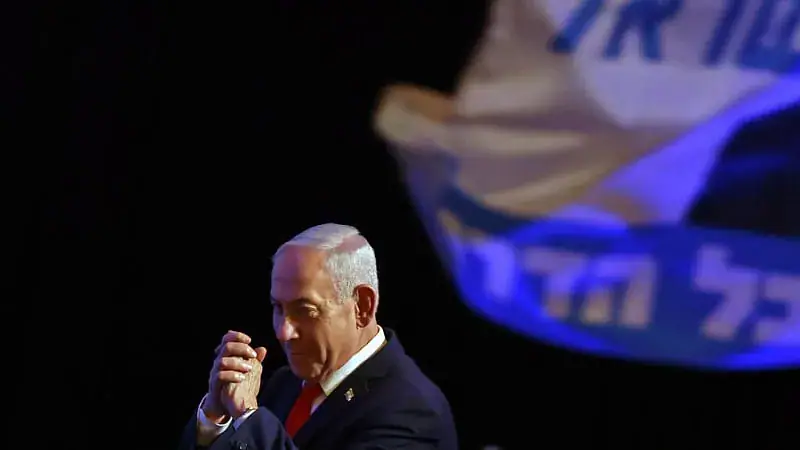
Israel's Prime Minister Benjamin Netanyahu addressed his supporters at an election night rally in Jerusalem after the first exit polls were announced. With 51.8 percent of ballots counted, Netanyahu's bloc was shown to have 55 of the 120 seats in parliament. His rival, Gadi Eisenkot, and his opposition bloc had 49 seats, while Arab parties secured 16 seats. The partial results indicate that the final outcome may change as more votes are counted.
Voter turnout was notably high, with nearly 78 percent of eligible voters casting their ballots, the highest participation rate since 1999. This election was seen as a significant test for Netanyahu, Israel's longest-serving prime minister, who has pushed the country to the right and initiated several wars in response to Hamas's October 7, 2023, attack. Both Netanyahu and Eisenkot have vowed to form a government despite neither being projected to win a majority.
Exit polls had suggested that Eisenkot's opposition bloc and Netanyahu's hard-right camp were neck-and-neck, each winning about 51 seats, which fell short of the threshold for a majority in parliament. The strongest gains were observed in Arab Israeli parties, whose voters turned out in large numbers against Netanyahu. These parties were projected to win 18 or 19 seats, a significant increase.
The partial results suggest that Eisenkot's bloc could potentially secure a majority if a coalition agreement is reached with the Arab parties. However, during the campaign, Eisenkot stated that he would not govern with Israeli Arab lawmakers, aligning with Netanyahu's stance that a government relying on Arab votes would lack legitimacy. Arab lawmakers could still offer support in parliamentary votes to sustain a minority government without being part of a coalition.
A clear majority for either camp is yet to be determined, which may lead to weeks of coalition negotiations, with the possibility of new elections if talks fail. This stalemate could temporarily benefit Netanyahu, who would remain caretaker prime minister until a new government is formed. Full results are expected by Thursday evening or Friday morning.
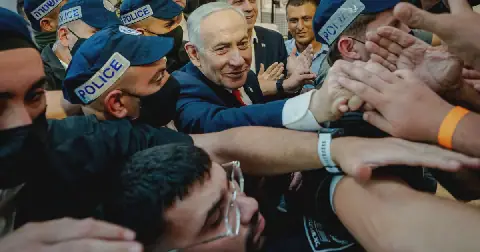
Netanyahu, greeting supporters at a Jerusalem convention center after 3 am on Wednesday, called for a "strong government of the right" and emphasized that the "Jewish and Zionist majority must unite." US President Donald Trump mentioned that his endorsement of Netanyahu had significantly helped the premier. In contrast, Eisenkot issued a veiled warning to Netanyahu, cautioning him against using Israel's security for political gain.
The election took place against the backdrop of Israel's increasing isolation on the world stage, influenced by the ongoing conflict in Gaza and tensions with Iran. Eisenkot shares many of Netanyahu's security views and has supported the Gaza offensive but has promised to foster a more inclusive atmosphere within Israel and curb violent West Bank settlers. Eisenkot urged swift action to form a government, stating, "The public has voted for change."
Key points
- Netanyahu's bloc leads with 55 seats after 51.8% of votes counted.
- No clear majority for either Netanyahu or Eisenkot's bloc.
- High voter turnout of nearly 78 percent recorded.