A convoy of 18 buses carrying 882 Sudanese nationals departed from Giza’s Faisal district, marking a significant development in the voluntary return of Sudanese nationals to their home country. The Hope Committee for Voluntary Return, a Sudanese civil-society group, coordinated the journey. This recent convoy included school and university students, reflecting a growing movement to war-scarred Sudan despite persistent insecurity and damaged infrastructure.
The Hope Committee reported that registrations were increasing among Sudanese communities across Egypt, with growing numbers registering from governorates nationwide. Maher El-Zein, head of the committee’s transport department, stated that returnees could contribute to Sudan’s reconstruction and efforts to restore stability. The committee’s bus journeys operate separately from the government-backed railway services that Egypt began providing for Sudanese returnees in July 2025.
The pace of returns has accelerated in September, with 980 Sudanese leaving Cairo on 7 September, followed by another 392 aboard eight buses three days later. Combined with the latest convoy, the three departures carried at least 2,254 people. In August, the committee said it transported 4,977 Sudanese nationals across six journeys. The decision to return involves weighing shrinking savings and limited employment opportunities in Egypt against the risks of returning to a country devastated by three years of war.
For many families, the journey home is a complex decision. Some returnees have spoken of relief and hope at going home, although they face damaged houses, disrupted schools and universities, limited electricity and water supplies, and an economy struggling to recover. The Hope Committee’s bus journeys operate separately from the government-backed railway services that Egypt began providing for Sudanese returnees in July 2025.
Egyptian National Railways operated 44 voluntary-return trains from Cairo to Aswan by 31 December 2025, carrying 42,944 Sudanese passengers. The programme operated about two trains a week during the final quarter of 2025. Registration closed on 31 October, after which the remaining services transported people who had applied before the deadline. The trains stopped in early 2026 after the registered backlog was cleared and the organizing body stopped accepting new applications.
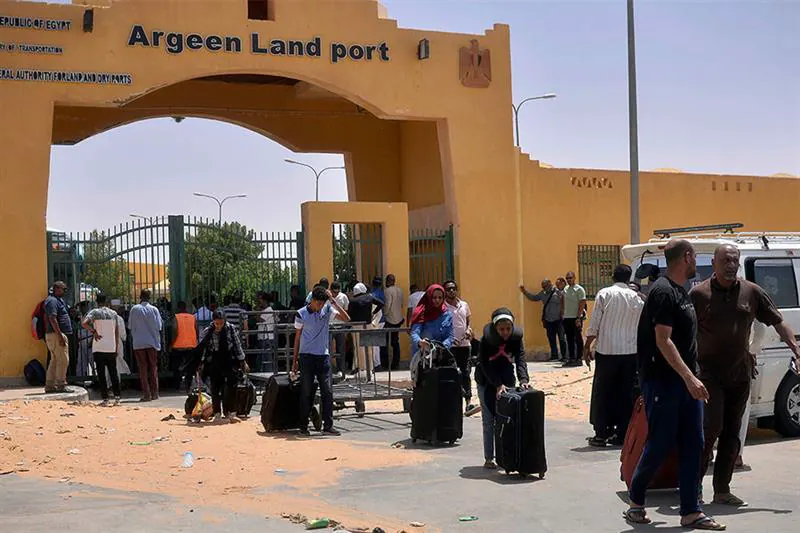
The railway and Hope Committee figures represent only parts of the wider return movement, which also includes privately organized buses, road travel and other initiatives. At a press conference held by the Sudanese Consulate General in Aswan on 29 September 2025, Sudanese Consul Abdel Qader Abdullah said 410,000 Sudanese nationals had returned through land crossings. Sudanese and Arab media later cited Abdullah as putting the number at approximately 428,676 by the end of 2025.
Returns began rising sharply after the Sudanese army regained control of Khartoum and surrounding areas. The International Organization for Migration reported a 44 percent increase in returns from Egypt during three weeks in April 2025 as improved security in parts of the capital encouraged displaced families to go home. The Hope Committee describes itself as an independent, national and non-political body established after the war erupted on 15 April 2023 to facilitate a “safe and dignified” return and connect returnees with reconstruction and recovery programmes.
Key points
- A further 882 Sudanese nationals have begun their journey home from Giza’s Faisal district.
- The Hope Committee for Voluntary Return coordinated the journey.
- The pace of returns has accelerated in September, with at least 2,254 people departing in three journeys this month.