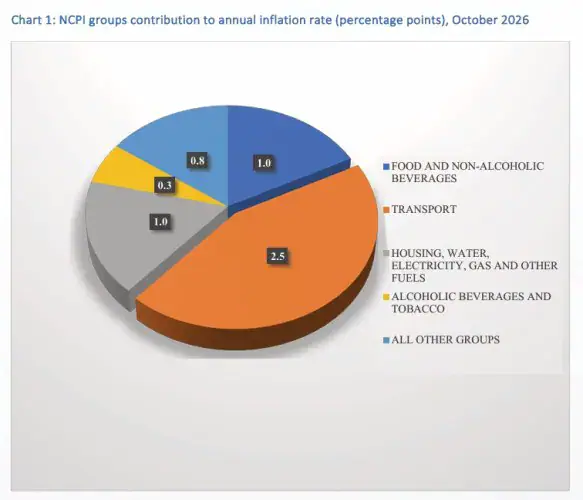
The annual headline inflation rate for October in Namibia stood at 5.6%, a significant increase from the 3.6% recorded in October 2025. On a monthly basis, inflation was recorded at 0.7%, up from 0.4% in the preceding month. This rise in inflation was largely driven by the transport category, which accounts for 14.3% of the consumer basket.
The transport category registered an inflation rate of 16.5% during October, compared to 2.1% observed in the same month of the preceding year. This increase was reflected in the subcomponents of operation of personal transport equipment, which rose from 1.7% to 22.7%, and public transportation services, which increased from 0.8% to 15.0%.
Core inflation, which excludes volatile items, stood at 3.7%, remaining below the headline inflation rate. The zonal inflation figures for October indicated that Zone 2, which includes the Khomas Region, recorded the highest annual inflation rate at 6.2%. Zone 3, comprising the /Kharas, Erongo, Hardap, and Omaheke regions, followed closely with an annual inflation rate of 6.1%.
Zone 1, which covers the northern part of the country, including regions such as Kavango East, Kavango West, and Ohangwena, registered the lowest annual inflation rate at 4.6%. The analysis of average retail prices for selected products in October revealed that Zone 3 recorded the highest average price for beef stew at N$137.49 per kilogram.
Zone 1 recorded the lowest average price for beef stew at N$102.96 per kilogram, while Zone 2 recorded the lowest average price for beef mince at N$116.80 per kilogram. Zone 3 registered the highest average price for beef mince at N$131.05 per kilogram. The prices were collected from various towns across the country, including Windhoek, Swakopmund, and Oshakati.
The price collection for Zone 2 covers Windhoek, with 218 retail outlets, while Zone 3 covers Keetmanshoop, Swakopmund, Mariental, and Gobabis, with a total of 314 retail outlets. The data collection process involves gathering prices from a wide range of retail outlets to ensure accurate and representative data.
The increase in inflation rate is a significant development for the Namibian economy, and it will be important to monitor future trends to determine the impact on consumers and businesses. The National Statistics Agency will continue to provide updates on the inflation rate and other economic indicators to help inform decision-making.
Key points
- The annual inflation rate in Namibia increased to 5.6% in October, driven by a surge in transport costs.
- The transport category registered an inflation rate of 16.5% during October, compared to 2.1% observed in the same month of the preceding year.
- Zone 2 recorded the highest annual inflation rate at 6.2%, while Zone 1 registered the lowest annual inflation rate at 4.6%.
Reporting sources
- Annual inflation spikes to 5.6% in October · Windhoek Observer