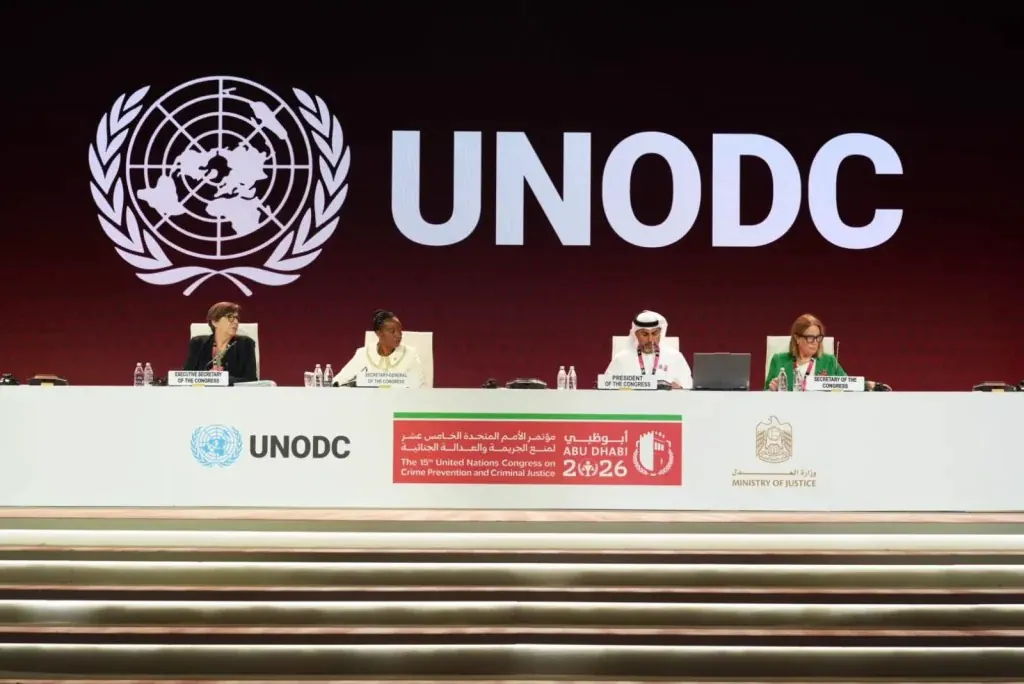
Morocco has welcomed the adoption of the Abu Dhabi Declaration, a significant document aimed at guiding international efforts in crime prevention and criminal justice. The declaration was adopted during the 15th United Nations Congress on Crime Prevention and Criminal Justice, held in Abu Dhabi. It sets out a framework for collective action on crime prevention, criminal justice, and the rule of law, and is expected to serve as a roadmap for the next five years.
The Abu Dhabi Declaration comprises 18 articles and 67 paragraphs, outlining a comprehensive framework for international cooperation on justice and the rule of law. Morocco's Secretary General of the Presidency of the Public Prosecution, Ahmed Ouali Alami, represented the Moroccan delegation during the closing session of the congress. He stated that Morocco participated in the event with a focus on prevention, cooperation, human dignity, institutional strengthening, and international solidarity.
The congress addressed various issues related to the changing nature of crime and the modernization of justice systems. Discussions included crime prevention, victim protection, human-centered justice, alternative sentencing, rehabilitation and reintegration, data collection and analysis, digital justice, and the responsible use of artificial intelligence. Ouali Alami emphasized that the modernization of justice should prioritize its human dimension, ensuring that technology serves people and the rule of law.
The Moroccan delegation highlighted the country's national commitment to continuing reforms and translating shared international commitments into measurable programs and policies. Ouali Alami stressed that the main challenge now is to move from declarations to implementation, international coordination to practical cooperation, and exchanges of experience to capacity building and tangible results for citizens.
The six-day congress brought together over 5,100 participants, including 40 justice ministers and 93 speakers representing states and regional groups. The event featured 170 side events and meetings, as well as 27 exhibition platforms and five initiatives launched during the congress. These activities provided a platform for governments, organizations, and institutions to present experiences and solutions related to human-centered justice and crime prevention.
Morocco also engaged in meetings with delegations, institutions, and international and regional organizations on the sidelines of the congress. Discussions covered criminal justice, digitalization, combating corruption and organized crime, capacity building, and judicial cooperation. Ouali Alami emphasized the importance of moving from declarations to implementation and practical cooperation.
The Abu Dhabi Declaration is expected to serve as a framework for international cooperation in areas such as human-centered justice, crime prevention, organized crime, cybercrime, financial and environmental crime, victim protection, rehabilitation, and social reintegration. Implementation remains a central challenge for participating states, which must work together to achieve tangible results.
Key points
- The Abu Dhabi Declaration sets out a framework for collective action on crime prevention, criminal justice, and the rule of law.
- Morocco participated in the congress with a focus on prevention, cooperation, human dignity, institutional strengthening, and international solidarity.
- The main challenge now is to move from declarations to implementation, international coordination to practical cooperation, and exchanges of experience to capacity building and tangible results for citizens.