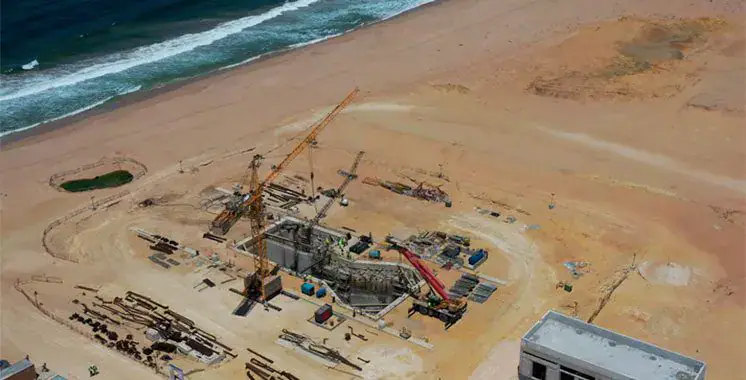
Morocco's Dakhla desalination project, located in the Bir Anzarane commune, has reached an advanced stage of completion. The project, which includes a desalination station, a 60 MW wind farm, and a 130 km irrigation network, aims to provide a sustainable source of water for the region. The project is part of the country's new development model for its southern provinces and has a planned annual capacity of 37 million cubic meters of water, with 30 million cubic meters allocated for irrigation and 7 million cubic meters for potable water supply.
The project, which has an investment of 2.6 billion dirhams, aims to preserve the Dakhla aquifer by reducing reliance on groundwater. The wind farm is already complete, while the desalination station and irrigation network are 97% and 99% complete, respectively. The project also includes 100 agricultural projects, each ranging from 5 to 10 hectares, which will be allocated to young people in the region, along with a support system.
The project's objectives include an annual production of 500,000 tons of vegetables, the creation of 30,000 permanent jobs, and the generation of a value-added output of over 1 billion dirhams. According to officials, the desalination station is expected to attract investments of nearly 4 billion dirhams in the agricultural sector and generate annual revenues exceeding 1 billion dirhams, in addition to creating around 20,000 jobs per year.
Morocco has prioritized its southern provinces in its new water policy, which aligns with the high-level directives of King Mohammed VI. The policy aims to ensure integrated, sustainable, and responsible management of water resources and enhance the country's water security. Recently, Morocco highlighted its experience in updating its water policy and reorienting its priorities at the 17th Arab Water Ministerial Council in Cairo.
The Moroccan ambassador to Egypt, Mohamed Aït Ouali, stated that the country's updated water policy is based on three main axes: diversifying water supply sources, strengthening solidarity between regions and different water uses, and adopting a long-term planning approach. He also mentioned that Morocco's plans for integrated water resource management have been approved, and the development of the National Water Plan up to 2050 is nearing completion.
Morocco is committed to innovation and modern technologies in the water sector, and the country remains open to international cooperation and partnerships to address the complex challenges related to water. The ambassador invited partners to submit nominations for the Hassan II Global Water Prize, which will be awarded at the 2027 World Water Forum in Saudi Arabia.
The 17th Arab Water Ministerial Council, held in parallel with the 7th Arab Water Conference, brought together representatives from Arab countries and regional and international organizations. The council discussed the implementation of the Arab Water Security Strategy up to 2030, the achievement of Sustainable Development Goals related to water, and the protection of Arab rights to water resources.
Key points
- The Dakhla desalination project is 97% complete and aims to provide a sustainable source of water for the region, with a planned annual capacity of 37 million cubic meters of water.