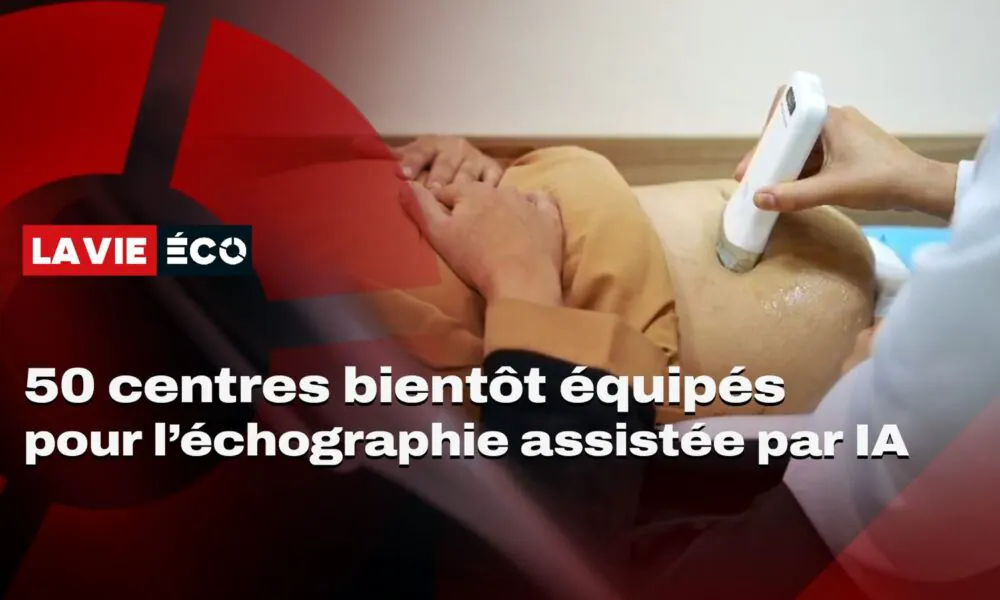
Morocco's Ministry of Health and Social Protection has launched an expansion of its AI-powered prenatal ultrasound program in the Béni Mellal-Khénifra region. The initiative aims to improve access to quality healthcare for pregnant women in rural areas. The program was first tested in 10 health centers, where it enabled the follow-up of 416 patients and the analysis of over 16,500 fetal structures.
The AI-assisted ultrasound device is designed to support healthcare professionals in rural areas where specialized care is scarce. The portable ultrasound probe is connected to a tablet and guides healthcare workers through seven standardized scans. The AI system then analyzes the images in real-time, identifying and validating different fetal structures, as well as the placenta and amniotic fluid.
The program has shown promising results, with the duration of examinations reduced by two to three times. The AI-powered system also generates a medical report that is automatically reviewed and validated by a doctor. The program has been particularly beneficial in reducing the need for women to travel long distances for prenatal care, with an average distance of 90 kilometers reduced to zero.
The Ministry of Health plans to extend the program to 40 additional centers, bringing the total number of establishments covered in the region to 50. This expansion is expected to improve the orientation of patients and enable better detection of potential complications during pregnancy. The program also aims to facilitate the early identification of certain fetal malformations that can be detected during the first trimester.
The AI-assisted ultrasound program is part of Morocco's efforts to improve maternal healthcare in rural areas. The program has already demonstrated its effectiveness in enhancing access to quality care and reducing the burden on healthcare systems. The Ministry of Health plans to gradually generalize the program nationwide, based on the results of the Béni Mellal-Khénifra region.
The program has also enabled the creation of a centralized patient file, accessible during different consultations. The digitization of prenatal care has streamlined the process, allowing healthcare professionals to access patient data and make informed decisions. The program's success is expected to have a positive impact on maternal and child health outcomes in Morocco.
The Moroccan government's investment in AI-powered healthcare technology is expected to have long-term benefits for the country's healthcare system. The program's expansion will depend on the evaluation of its effectiveness and the assessment of its impact on maternal and child health outcomes. Key stakeholders will monitor the program's progress and make adjustments as needed.
Key points
- The program aims to improve access to quality prenatal care for women in rural Morocco.
- The AI-assisted ultrasound device has reduced examination time by two to three times.
- The program plans to expand to 50 centers in the Béni Mellal-Khénifra region, with potential nationwide generalization.