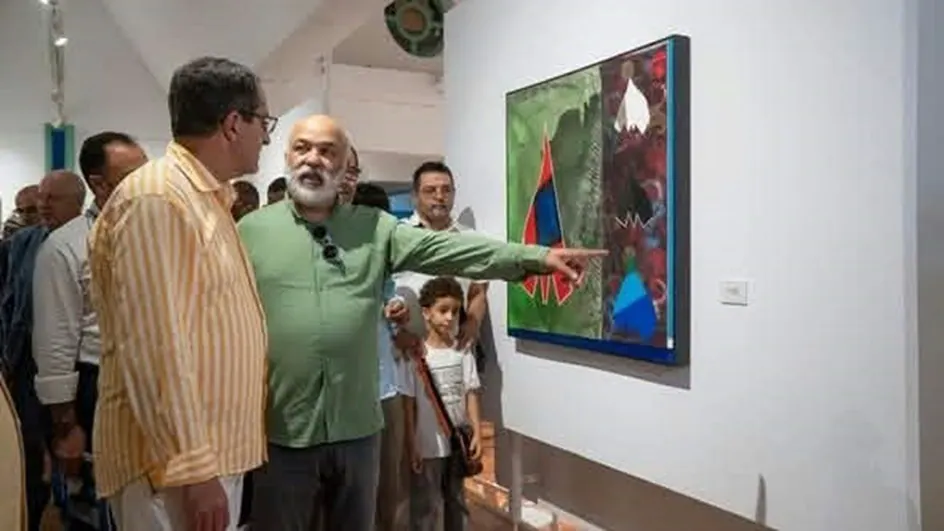
In the city of Asilah, two Moroccan artists, Yunes Kharraz and Mohamed Merabiti, are exhibiting their latest works as part of the 47th season of the Asilah festival. Their artwork showcases two distinct styles, yet shares a common goal: to create a visual language that not only represents the world but also redefines it. Kharraz's work is characterized by constant movement, with shapes forming and breaking apart, and lines that create new life rather than simply defining objects.
Kharraz's use of color is not merely decorative, but a driving force that pushes the painting from within, opening up new spaces and closing others. His artwork invites the viewer to enter, rather than simply understand, the piece. The circular motif is a recurring theme in Kharraz's work, often repeated in a rhythmic and physical manner, creating a sense of dynamic movement. This repetition is not mechanical, but rather a deliberate and expressive gesture.
In contrast, Mohamed Merabiti's work takes a different approach. While Kharraz's art is characterized by movement and fluidity, Merabiti's pieces are rooted in geometric and spiritual foundations. The dome is a central motif in Merabiti's work, but it is not a realistic representation. Rather, it is a starting point for exploring the relationship between the earth and the sky, matter and spirit, and geometry and color.
Merabiti's use of color is more restrained and deliberate, with a focus on balance and harmony. The colors he chooses - red, blue, black, and white - work together to create a sense of tension and resolution. The white, in particular, allows the shapes to breathe, while the black provides depth and contrast. Merabiti's artwork is not static, despite its geometric basis, as it contains subtle references to human experience, nature, and spiritual realms.
The meeting between Kharraz and Merabiti is significant, as it highlights the diversity and richness of contemporary Moroccan art. Despite their differences, both artists reject the idea of static art, instead opting for dynamic movement and contemplation. Kharraz's work dissolves boundaries, releasing energy, while Merabiti's art builds boundaries, allowing the spirit to ascend.
The exhibition in Asilah is more than just a joint showcase; it is a beautiful encounter between two approaches to understanding the world. Kharraz's art is characterized by constant movement, while Merabiti's work seeks spiritual center. Between movement and stillness, dissolution and geometry, and intuition and contemplation, the exhibition affirms that art does not require a single language to convey depth and meaning.
The works of Kharraz and Merabiti demonstrate that Moroccan contemporary art can be both faithful to its roots and open to experimentation, carrying memory without being bound by it, and inspiring the spirit without abandoning modernity. Their art is a testament to the power of creativity and the boundless possibilities of the human imagination.
Key points
- The exhibition showcases the unique styles and techniques of two Moroccan artists, Yunes Kharraz and Mohamed Merabiti.
- Kharraz's work is characterized by movement and fluidity, while Merabiti's art is rooted in geometric and spiritual foundations.
- The meeting between Kharraz and Merabiti highlights the diversity and richness of contemporary Moroccan art.