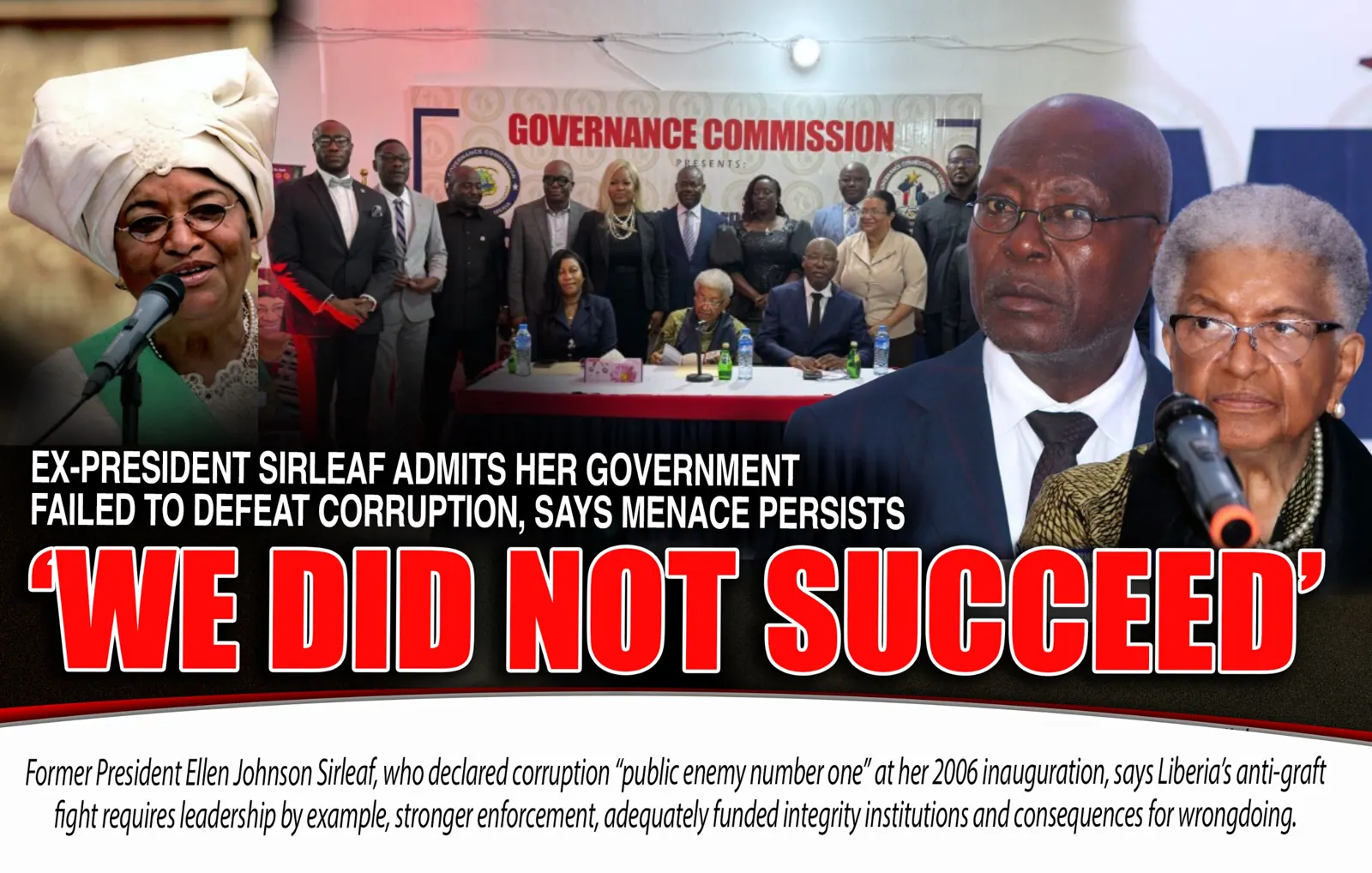
Former President Ellen Johnson Sirleaf has acknowledged that her administration failed to defeat corruption in Liberia during her 12-year presidency. Despite extensive institutional reforms, Sirleaf admitted that the menace remains deeply entrenched and continues to confront the country today. She made the candid admission while delivering the keynote address at a Governance Commission symposium on good governance in Monrovia.
The event marked the inaugural ceremony marking October as Liberia's Month of Good Governance, an initiative declared by President Joseph Nyuma Boakai. Sirleaf's admission comes nearly two decades after she famously declared corruption "public enemy number one" during her inauguration in January 2006. She served two constitutional terms, leaving office in January 2018 after peacefully transferring power to then-President-elect George Manneh Weah.
Reflecting on the shortcomings of her administration's anti-corruption campaign, Sirleaf pointed to weak enforcement, inadequate funding for integrity institutions, and the failure to prosecute individuals accused of wrongdoing. She noted that audits were published and then forgotten, too few cases reached the courtroom, and fewer ended in conviction. Sirleaf also acknowledged that some institutions were given broad mandates without the budgetary resources required to effectively perform their functions.
Sirleaf defended the governance reforms undertaken during her administration, recalling that her government inherited a country emerging from years of civil war, institutional collapse, and widespread public distrust. She cited strengthening the General Auditing Commission and establishing the Liberia Anti-Corruption Commission. Her administration also established the Public Procurement and Concessions Commission and reviewed concession agreements signed during the civil war.
Sirleaf said the experience taught her that establishing institutions and passing laws, while important, were insufficient to defeat corruption. She emphasized that accountability without consequence will only be a report on the shelf. According to Sirleaf, laws provide the framework for accountability, but their effectiveness depends on leaders, citizens, and institutions working together to enforce them.
Sirleaf stressed that public officials must lead by example and demonstrate integrity in the exercise of their responsibilities. She called for Liberia's integrity institutions to receive the full budgetary allocations required under the law, while challenging those institutions themselves to uphold the standards they are mandated to enforce. Sirleaf also called for greater respect for the judiciary and implementation of court decisions.
Beyond corruption, Sirleaf used the symposium to place Liberia's governance crisis within the broader context of the country's history. She recounted Liberia's establishment by the American Colonization Society and the declaration of independence in 1847. Sirleaf noted that Liberia's history was also marked by the exclusion of the indigenous majority from political and economic power, which created resentment that eventually contributed to the 1980 military coup and the civil wars that followed.
Key points
- Former President Ellen Johnson Sirleaf admits her administration failed to defeat corruption in Liberia despite extensive reforms during her 12-year presidency.
- Sirleaf cites weak enforcement, inadequate funding for integrity institutions, and failure to prosecute individuals accused of wrongdoing as reasons for the failure.
- She emphasizes that accountability begins at the top and public officials must lead by example to effectively fight corruption.