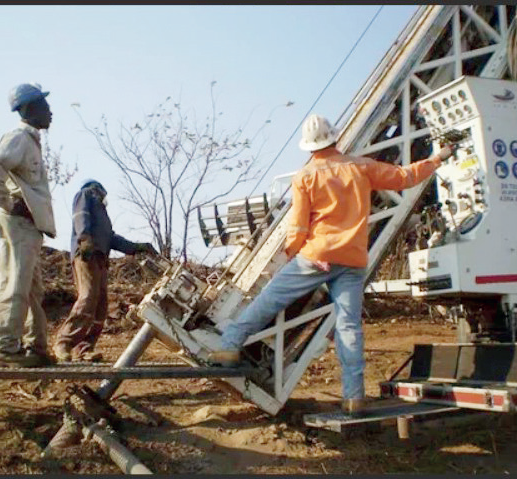
The Ministry of Mining in Malawi is optimistic that proposed amendments to the Minerals Act 2023 will promote value-addition and increase local participation in the sector. The reforms aim to strengthen local content requirements, encourage value addition, and tighten regulation of mineral exploration activities. This move is expected to raise the sector's contribution to the economy, currently at one percent. The proposed changes are under consultation and are expected to be tabled before Parliament.
Secretary for Mining Rodwell Mzonde stated that exporting processed mineral products instead of raw materials can create jobs, spur industrialisation, and increase the sector's contribution to gross domestic product. He emphasized that the reforms will increase local content in mining operations and create more jobs in the sector. The consultations are helping to shape the law to facilitate growth of the sector. Mzonde's comments were made at a stakeholder consultation meeting in Lilongwe.
The Malawi Women in Mining Association president Ashley Simbeye welcomed proposals for promoting value addition but expressed concerns that many small-scale miners, particularly women, lack the financial capacity to acquire processing equipment. Simbeye suggested that the government should put in place structures that support the value-addition value chain. This would enable small-scale miners to participate in value addition and benefit from the proposed reforms.
Chamber of Mines and Energy president Maxwell Kazako described the reforms as forward-looking but emphasized that increased investment in energy infrastructure will be critical to support large-scale mineral processing. Kazako cited reliable electricity supply as a major constraint to value-addition, stating that real mining operations require a lot of energy. He urged small-scale miners to form cooperatives to improve access to financing for machinery and equipment.
The mining sector currently contributes about one percent to Malawi's economy, according to the 2026 Malawi Government Annual Economic Report. Before 2014, mining accounted for roughly 10 percent of economic activity, prior to the suspension of production at Kayelekera Uranium Mine following a collapse in global uranium prices. The sector's contribution to the economy is expected to increase with the implementation of the proposed reforms.
Under the Malawi 2063 development blueprint, mining has been identified as a key growth sector expected to help the country attain lower-middle-income status by 2030 and upper-middle-income status by 2063. The blueprint highlights the importance of the mining sector in driving economic growth and development. The proposed reforms are a step towards achieving this goal.
The stakeholder consultation meeting in Lilongwe brought together various stakeholders to discuss the proposed reforms and their potential impact on the sector. The meeting provided a platform for stakeholders to share their views and concerns on the proposed changes. The Ministry of Mining is expected to consider the feedback from the consultations in shaping the final law.
Key points
- Proposed reforms to the Minerals Act 2023 aim to promote value-addition and increase local participation in Malawi's mining sector.
- The mining sector currently contributes about one percent to Malawi's economy.
- Increased investment in energy infrastructure is critical to support large-scale mineral processing in Malawi.