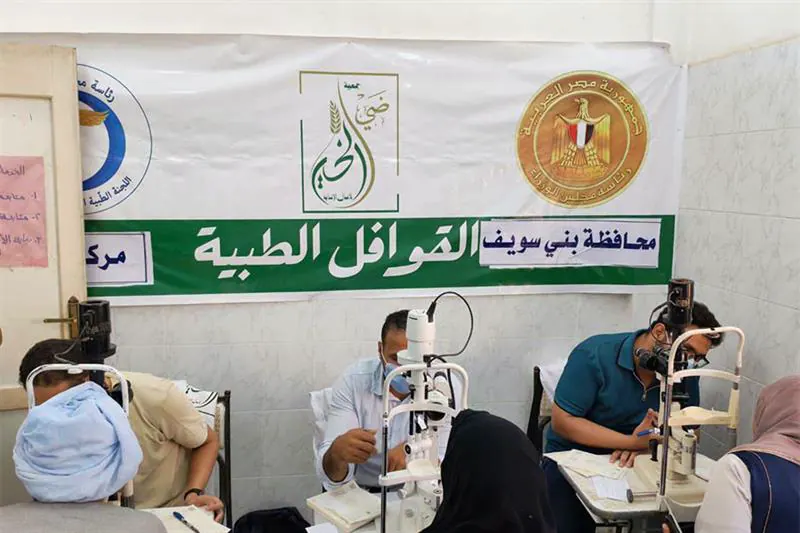
Medical convoys organized by Egypt's cabinet examined 5,271 people in a Beni Suef village and two Assiut districts. The convoys, which took place in early September, identified 526 cases requiring surgery and dispensed 833 pairs of prescription glasses. Prime Minister Mostafa Madbouly reviewed reports on the two convoys, which were organized by the cabinet's Higher Medical and Relief Committee. The convoys provided free examinations, diagnostic tests, treatment, medicines, and glasses across several medical specialties.
The first convoy took place in Eqfahs village in Beni Suef's Al-Fashn district on 12-13 September. It examined 2,050 people, including 650 at ophthalmology clinics. The convoy dispensed 354 glasses and identified 180 cases requiring eye surgery. Comprehensive clinics examined another 1,400 people and identified 74 cases requiring surgery. The convoy was conducted in cooperation with the Dey Al-Kheir Foundation for Humanitarian Work.
The second convoy took place across Assiut's El-Badari and Abnoub districts from 14 to 17 September. It examined 3,221 people, including 1,127 at ophthalmology clinics. The convoy dispensed 479 glasses and identified 187 people requiring eye operations. Comprehensive clinics examined another 2,094 people and identified 85 requiring surgical intervention. Assiut Governor Mohamed Alwan inspected the convoy and reviewed the medical services offered to residents.
Committee chair Naglaa Abdel-Moneim said both convoys provided free examinations, diagnostic tests, treatment, medicines, and glasses across several medical specialties. Cases requiring surgery were referred to complete the necessary procedures. The 526 surgical referrals come as Egypt continues its presidential waiting-list initiative, alongside national cancer screening and the phased rollout of universal health insurance.
Prime Minister Madbouly praised the committee and civil-society organizations involved in delivering healthcare to underserved communities. Comparable partnerships have supported border-region health campaigns in other parts of the country. The committee thanked the Beni Suef and Assiut governors, provincial executive and health authorities, the Dey Al-Kheir Foundation, and the Egyptian Cure Bank for supporting the convoys.
Eqfahs village, where one of the convoys took place, had 21,316 residents according to the 2017 national census. The village has seen previous local projects, including an existing sewage-lifting station documented by the Beni Suef water utility in 2019, and a village milk-collection substation operating by 2020. The milk facility formed part of a five-village network employing 65 workers and receiving 22 tonnes of milk from 1,050 suppliers.
The medical convoys are part of Egypt's efforts to provide healthcare to underserved communities. The country has previously deployed similar rural medical convoys to provide free examinations and treatment in Upper Egypt. The government continues to work on expanding healthcare services, including the rollout of universal health insurance and national cancer screening programs.
Key points
- 5,271 people examined in medical convoys in Beni Suef village and Assiut districts
- 526 cases requiring surgery identified, 833 pairs of prescription glasses dispensed
- Convoys provided free examinations, diagnostic tests, treatment, medicines, and glasses across several medical specialties