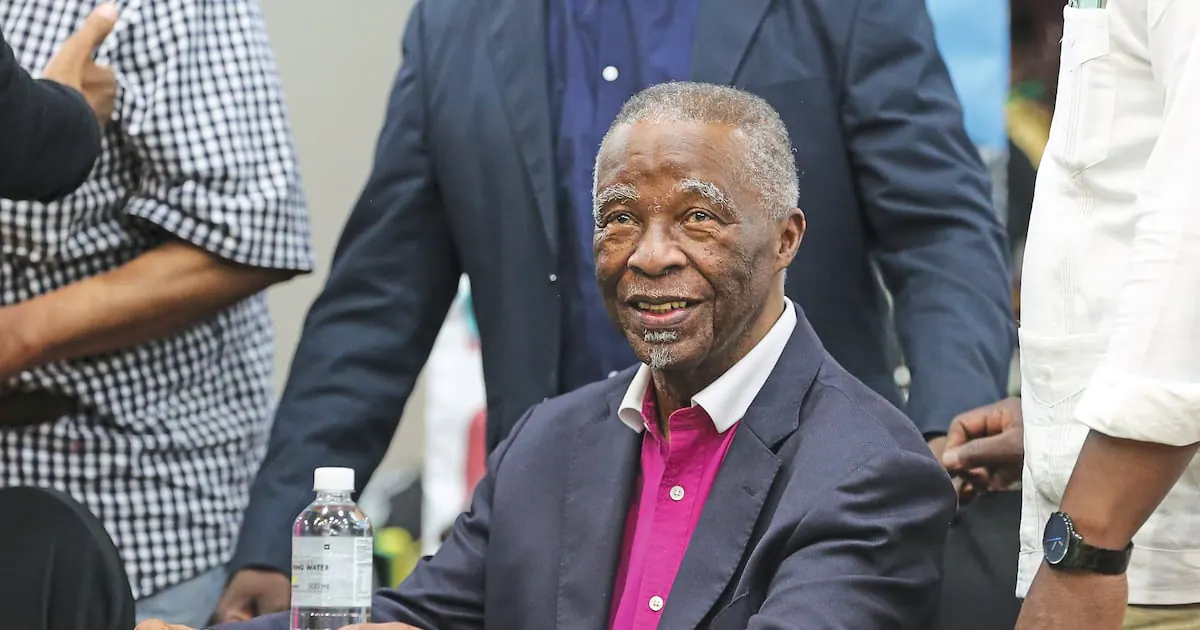
Former South African President Thabo Mbeki has been hailed by US Ambassador Leo Brent Bozell III as one of Africa's great statesmen, sparking controversy and highlighting the complexities of US-South Africa relations. Mbeki's presidency was marked by warnings against Western intervention in African affairs, making the US diplomat's comments ironic. The Thabo Mbeki Foundation has since released a 123-page paper arguing that the deteriorating relationship between Pretoria and Washington cannot be understood solely through disputes over land reform, BEE, farm attacks, or South Africa's foreign policy.
At the center of the foundation's argument is the "unresolved national question" - the enduring consequences of colonialism and apartheid in South Africa, and slavery and racial segregation in the US. Mbeki's political worldview was shaped by his experiences, including his father's imprisonment on Robben Island and his own life in exile. His son, Monwabisi Kwanda, disappeared in 1981, and his younger brother Jama went missing in 1982, both presumed dead. These experiences exemplify the human cost of the political struggle to which Mbeki devoted his life.
Mbeki's handling of Zimbabwe provides an example of his resistance to external intervention. When Robert Mugabe's government faced international criticism for repression, land seizures, and economic collapse, Mbeki resisted calls for Western intervention, citing South Africa's history and cautioning against foreign influence. However, this approach has been criticized for failing to acknowledge the reality of domestic repression. The challenge lies in balancing the risks posed by foreign influence with the need to address domestic issues.
The Thabo Mbeki Foundation argues that abandoning transformation risks entrenching a "two nations" reality, where economic divisions follow racial lines. The foundation invokes America's own history, including persistent black poverty after formal discrimination was abolished. However, the fact that inequality exists does not justify legislation favoring one racial group over another. South Africa's constitution attempts to balance equality before the law with measures to advance people disadvantaged by apartheid.
Mbeki's life illustrates the power of path dependency, where his experiences shaped his perceptions and informed his politics. His worldview, while conceived in a specific historical context, continues to influence his views on external intervention. The collective memory that once provided the moral foundation for liberation can become an interpretive lens through which subsequent conflicts are understood.
South Africa's challenge now is not to forget its history but to ensure that history remains a guide rather than a prison. The debate surrounding US intervention and Mbeki's legacy highlights the need for nuanced understanding and critical evaluation of historical context. As South Africa navigates its complex relationships with the US and other nations, it must balance its history with the demands of the present.
Ultimately, the responsibility to interrogate historical memory and evaluate its relevance to contemporary challenges is crucial. Mbeki's legacy serves as a reminder of the complexities of South Africa's history and its ongoing impact on the country's relationships with the world. As the country moves forward, it must draw on its history to inform its decisions, rather than being constrained by it.
Key points
- Mbeki's resistance to external intervention in Zimbabwe has been criticized for failing to acknowledge domestic repression.
- The Thabo Mbeki Foundation argues that abandoning transformation risks entrenching a "two nations" reality in South Africa.
- Mbeki's life illustrates the power of path dependency, where his experiences shaped his perceptions and informed his politics.