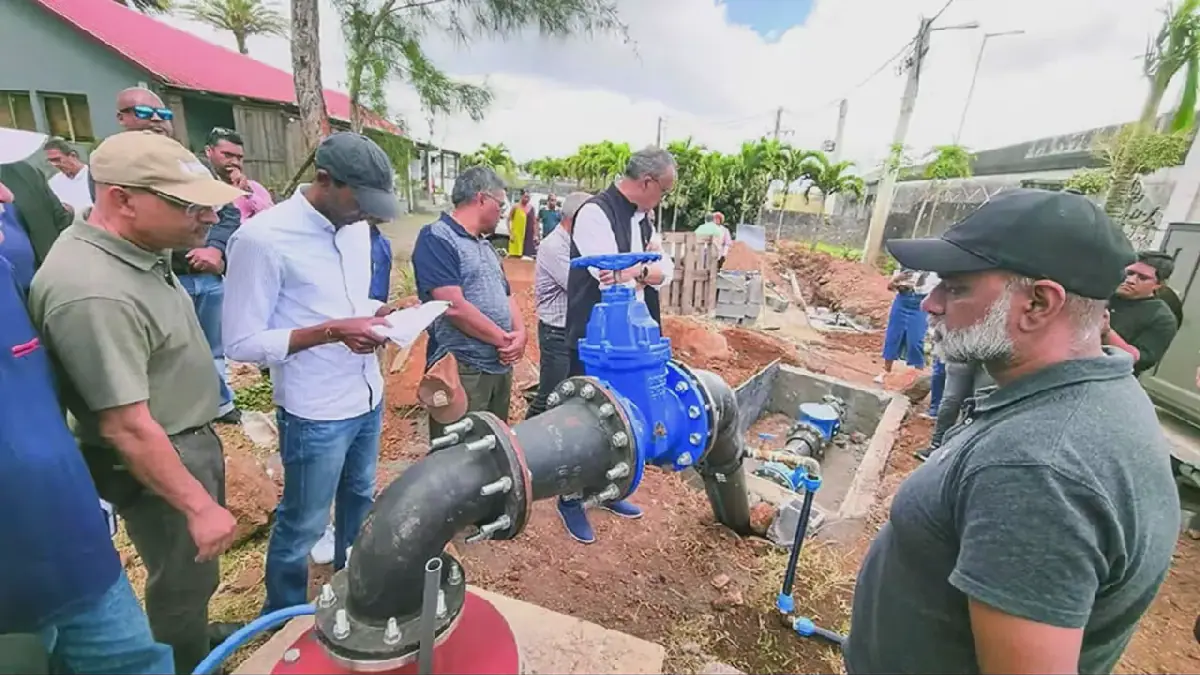
The Mauritian government is set to commission 12 new Containerised Pressure Filters (CPF) across the country by the end of December. These systems will add 25 million liters of water per day to the national grid. This development is part of the government's efforts to address the ongoing water crisis. The CPFs will supplement the existing 12 operational units, 20 exploited boreholes, and the water transfer from Mare-Longue to La Marie.
The Ministry of Public Services reports that the current three-pronged approach - CPFs, boreholes, and water transfer - is injecting 81 million liters of water per day into the network. However, the country's water reserves continue to dwindle, with an overall filling rate of 46.3%. The Mare-aux-Vacoas reservoir has the lowest filling rate at 32%. The new CPFs aim to diversify and increase the water supply.
The 12 new CPFs will be deployed in stages between late November and December. Each unit has a capacity ranging from 1.5 to 2.6 million liters per day. The first CPF will be operational in late November at Bassin Aza Lavenir, serving L'Avenir and Saint-Julien. Seven more units are scheduled for mid-December in various locations.
The new filtration systems will primarily serve regions such as Flacq, Centre-de-Flacq, Montagne-Blanche, Brisée-Verdière, Quartier-Militaire, and Rivière-Noire. The CPF at Unité will have a capacity of 2 million liters per day, serving Lallmatie, Saint-Pierre, and Bon-Accueil. The Bramsthan and Argy units will also have a capacity of 2 million liters per day.
The Ministry of Public Services reports that 12 CPFs are already operational, injecting 25.5 million liters of water per day into the network. Additionally, 20 boreholes are producing 43.5 million liters per day. These boreholes serve various regions, including Flacq, Belle-Mare, and Flic-en-Flac.
The water transfer from Mare-Longue to La Marie adds 12 million liters of water per day to the network. This, combined with the CPFs and boreholes, brings the total additional water supply to 81 million liters per day. The Central Water Authority (CWA) is monitoring the situation and may impose further restrictions if necessary.
Despite the current situation, no new water consumption restrictions have been announced. However, CWA Director General Shiam Thannoo states that several scenarios are being studied to address potential future challenges. Restrictions have already been tightened in areas supplied by Mare-aux-Vacoas, with residents in Vacoas/Phœnix receiving only five hours of water supply every other day.
Key points
- The 12 new CPFs will add 25 million liters of water per day to the national grid.
- The current three-pronged approach is injecting 81 million liters of water per day into the network.
- The overall filling rate of the country's water reserves is 46.3%.