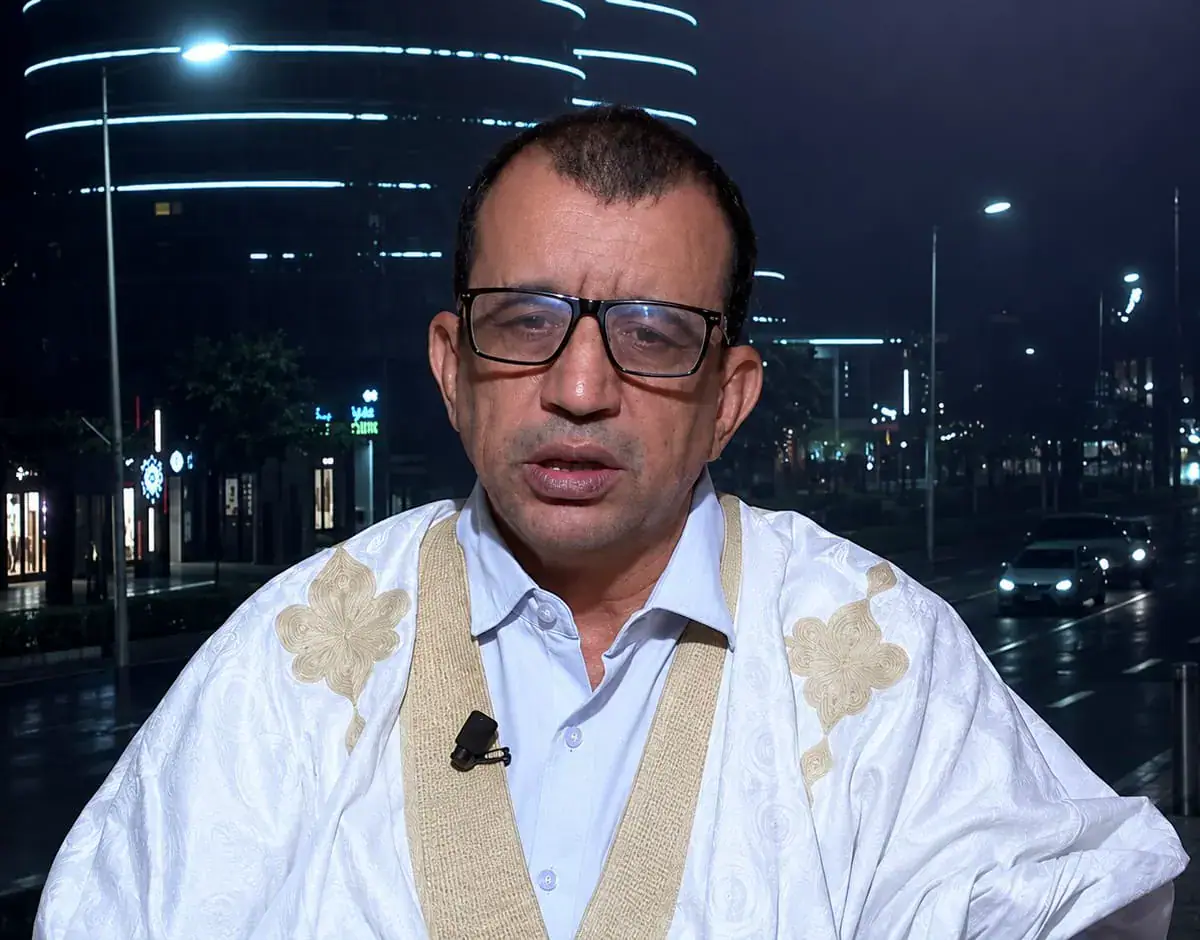
Former Mauritanian Minister Sidi Mohamed Ould Maham recently shared his thoughts on the Western Sahara conflict. He agrees with many points made by Minister Sidi Mohamed Ould Maham, particularly regarding the political and developmental aspects and the need for a peaceful approach to avoid further destabilization in the region. However, Ould Maham expressed some reservations regarding the tactical and military aspects of the conflict.
Ould Maham disputes the idea that military access to the Amakale-Karkarat strip requires crossing Mauritanian territory. He argues that modern warfare, specifically the fifth generation of warfare (2010-2026), relies on asymmetric warfare, smart systems, and advanced technology. This allows for long-range strikes using drones and cruise missiles without needing to move ground troops or violate Mauritania's sovereignty.
The former minister cites the Yemen conflict as an example, where local forces have successfully targeted strategic objectives and vital installations hundreds of kilometers away without needing to share a border or cross into third-country territory. Ould Maham emphasizes that modern warfare has changed the way conflicts are fought, making it possible to strike targets from a distance.
Ould Maham also criticizes the article for overlooking the concept of asymmetric warfare. He notes that the less well-equipped side does not seek to control territory or engage in conventional battles. Instead, they rely on small, decentralized cells to carry out low-cost attacks to sustain a prolonged conflict without needing extensive supply lines.
The former minister points to the Sudan civil war as an example, where lightly armed and highly mobile units have used commercial drones and kamikaze drones to target airbases and fortified command centers. This approach allows for effective action without requiring control of territory or conventional airpower.
Ould Maham also questions the feasibility of completely sealing off low-altitude airspace. He notes that small drones can fly at very low altitudes, making them difficult to detect using traditional radar systems. This makes it challenging to impose 100% surveillance over a 2700 km-long wall.
The former minister concludes that the role of the sand wall has changed since the 1980s. While it remains effective in preventing ground advances, it has become a fixed target for sustained attacks using kamikaze drones. The conflict in Nagorno-Karabakh (2020) serves as an example, where fortified defenses and trenches were rendered ineffective by precision strikes from drones and cruise missiles.
Key points
- The conflict in Western Sahara requires a negotiated settlement rather than a purely military solution.