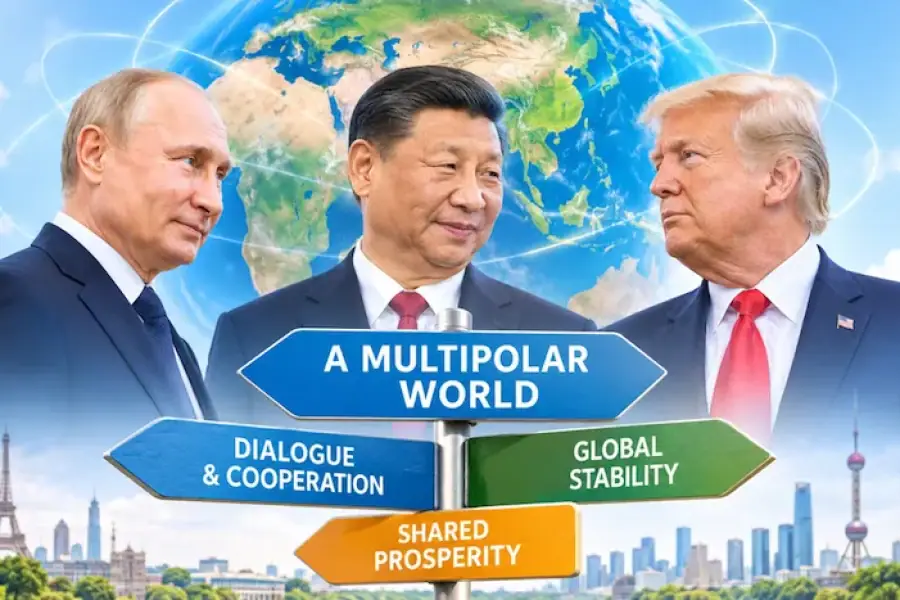
The summit between Russian President Vladimir Putin, Chinese President Xi Jinping, and US President Donald Trump in Shenzhen has been hailed as a significant event in the emergence of a multipolar world order. According to Maliweb.net, this meeting represents a shift away from the unipolar world that existed after the Cold War, with the US as the sole superpower. The new world order is characterized by the growing influence of Asia and the rise of multiple regional powers.
The summit has drawn comparisons to the 1945 Yalta Conference, where the Allied powers discussed the post-war order. However, Maliweb.net notes that this comparison is misleading, as the current global landscape is much more complex, with multiple emerging powers and a significant global South. The article cites Sarang Shidore, director of the Global South program at the Quincy Institute, who emphasizes that the symbolism of a concert of great powers is important, but the world today is far more complex than the international system of 1945.
The article highlights that the three leaders have different visions for the world order. Russia favors a multipolar and polycentric world, while China promotes multipolarity, development, and better representation for the global South. The US, on the other hand, is seeking to maintain its strategic advantage and global position. Despite these differences, the leaders have agreed on four key areas: reform of the UN, energy security, international criminal jurisdiction, and reducing nuclear risks.
The joint statement issued after the summit has been seen as a significant achievement, given the tensions between the three powers. According to Pascal Lottaz of Neutrality Studies, the statement's value lies in creating a channel of communication between the competitors, particularly at a time of great global volatility. However, the article notes that the statement is not a binding treaty and that sustained negotiations, verification mechanisms, and arms control agreements are needed to make a meaningful impact.
The article analyzes China's strategy, citing a conversation between Sheng Zhang and Pascal Lottaz in Neutrality Studies. China's approach is characterized as diplomatic, reassuring, and patiently strategic. By engaging with Trump, China aims to defuse tensions, preserve its economic and technological maneuvering room, and avoid situations that could harm its long-term development. The summit is seen as a way for China to manage rivalry rather than resolve it.
The article also notes that Russia benefits from the summit by demonstrating that Western sanctions have not rendered it diplomatically insignificant. President Putin's presence underscores Moscow's status as a major strategic player, particularly in nuclear security and Eurasia. Meanwhile, Trump's participation may indicate that the US can no longer manage all regional conflicts while containing China and managing Russia.
The implications of the summit for Europe, Latin America, and the global South are significant. If major international negotiations increasingly take place outside the European diplomatic framework, the EU risks being relegated to the role of strategic observer. The article suggests that the EU's own fragmentation and dependence on US guarantees may exacerbate this trend.
Key points
- The Poutine-Xi-Trump summit marks a shift towards a multipolar world order, with growing Asian influence and the rise of multiple regional powers.
- The summit has highlighted differences between the US, China, and Russia on the world order, but also created a channel of communication between the three competitors.
- The implications of the summit for Europe, Latin America, and the global South are significant, with the EU potentially being relegated to the role of strategic observer.
Reporting sources
- Pourquoi avons-nous besoin d’un nouvel... · Maliweb.net