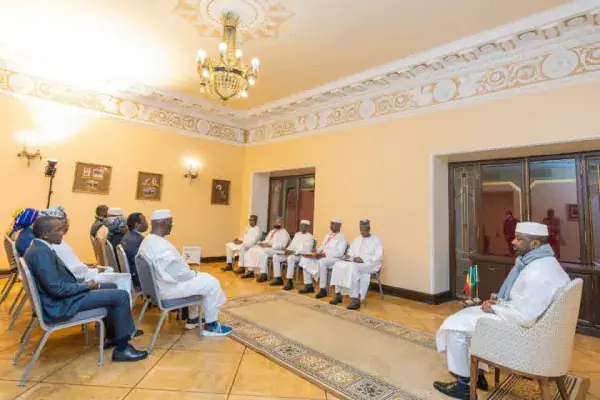
On the sidelines of the 3rd Russia-Africa Summit, Mali's Transition President, General Assimi Goïta, received a delegation of Mali's private sector leaders. The meeting, which took place at the end of the Forum's proceedings, was attended by several high-ranking government officials, including Minister of State for Economy and Finance Alousséni Sanou and Minister of Industry and Commerce Moussa Alassane Diallo. The private sector delegation was led by Mandiou Simpara, President of the Malian Chamber of Commerce and Industry.
The discussions focused on the operational aspects of the Russia-Africa Summit and the potential for concrete partnerships between Mali and Russia. The private sector delegation emphasized the need to strengthen national production and promote local transformation through structured industrial units to reduce dependence on imports. They also sought support from the government in securing joint ventures with Russian companies and other partners in areas such as fertilizers, agricultural equipment, energy, and logistics.
The meeting was seen as a significant step towards achieving the goals of the Russia-Africa Summit. According to Mandiou Simpara, President Goïta listened to the private sector's concerns and pledged to support their initiatives. Simpara highlighted the importance of collective mobilization of the private sector to drive Mali's economic development. He also emphasized the need for Mali to produce what it consumes and transform its products locally through industrial units.
The audience with President Goïta confirms his commitment to making the private sector a key driver of Mali's economic sovereignty. The meeting follows a series of diplomatic and political engagements between Mali and Russia, and aims to anchor the agreements reached at the summit in the country's productive sector. The private sector delegation included representatives from various sectors, including agro-industry, construction, logistics, and energy.
The discussions with the private sector delegation covered three main areas: agricultural development, trade revival, and industrialization. The delegation also sought support from the government in securing partnerships with Russian companies in areas such as fertilizers and agricultural equipment. According to Simpara, President Goïta's engagement with the private sector demonstrates his commitment to driving Mali's economic development.
The meeting between President Goïta and the private sector delegation was widely covered in the Malian media. The President's engagement with the private sector is seen as a positive step towards driving Mali's economic development and promoting partnerships with Russia and other countries. The Russia-Africa Summit provided a platform for Mali to strengthen its relationships with other countries and promote its economic interests.
The Malian government's efforts to drive economic development and promote partnerships with other countries are ongoing. The country's private sector is expected to play a key role in driving economic growth and development. With the support of the government, the private sector is poised to make significant contributions to Mali's economic development and promote partnerships with Russian companies and other partners.
Key points
- President Assimi Goïta's meeting with Mali's private sector leaders aimed to drive economic partnerships with Russia.
- The private sector delegation emphasized the need to strengthen national production and promote local transformation.
- The meeting confirms President Goïta's commitment to making the private sector a key driver of Mali's economic sovereignty.