The "Becoming the Ocean" exhibition, co-produced by the Kamel Lazaar Foundation and the Centre d'Art Contemporain Genève, opened on October 24 at Kechlet El Attarine in Tunis. This former 19th-century Ottoman military barracks, located in the heart of the Medina of Tunis, has been partially restored for the occasion. The exhibition is part of Jaou Tunis, a biennale that brings together art, culture, and politics. The show features 16 artists from the Global South and its diasporas, including Tabarak Allah Abbas, Younès Ben Slimane, and Mona Benyamin.
The exhibition's title, "Becoming the Ocean," was inspired by a parable attributed to Gibran Khalil Gibran, which describes a river that, as it approaches the ocean, mistakes dissolution for annihilation. However, this perceived end is actually a transformation into something greater. The exhibition explores the idea of transformation and resistance, particularly in the context of the body. The artists' works challenge the dominant narratives of modernity, which are based on the separation of people, histories, and living beings.
The exhibition is curated by Andréa Bellini and Lina Lazaâr, who aimed to create a platform for artists to express themselves freely. The show features a range of media, including video installations, that explore the ways in which individuals navigate moments of transition and uncertainty. The artists' works are a response to the current state of the world, where structures are crumbling, and the future is uncertain. They offer a vision of transformation and resistance, rather than resignation or amnesia.
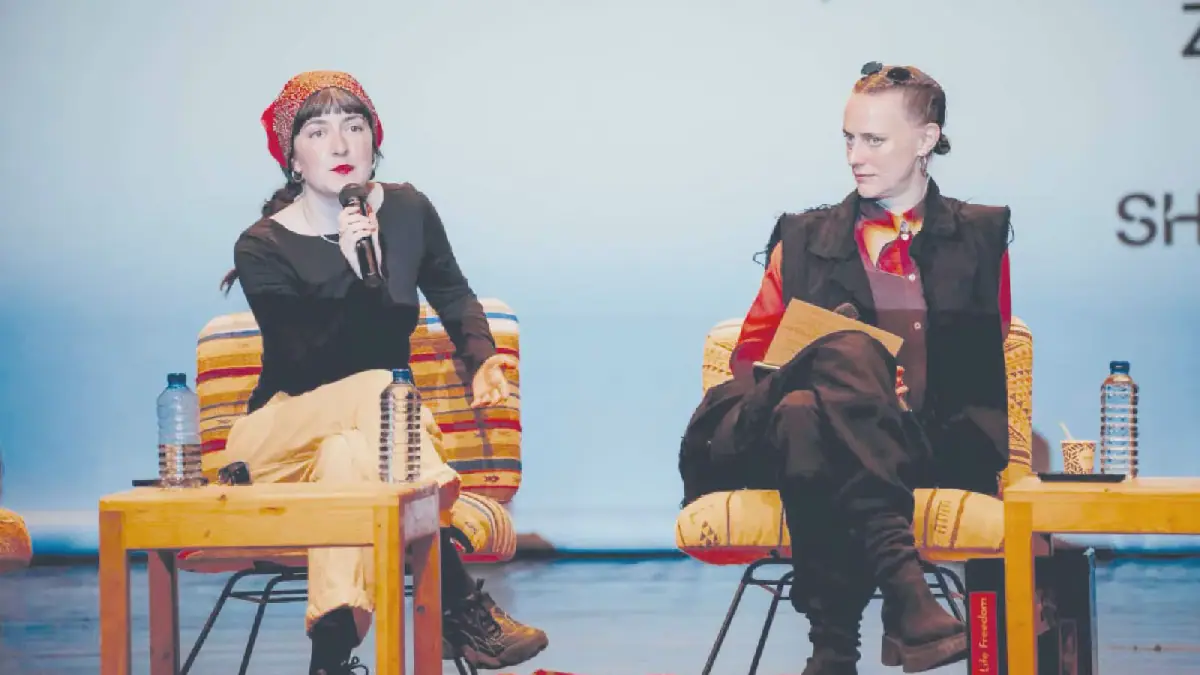
As part of the exhibition, a series of events and discussions were organized, including a conversation between Palestinian writer and poet Mohammed El-Kurd and researcher Anthony Downey. They discussed the role of images and evidence in shaping public narratives, particularly in the context of Palestine. El-Kurd highlighted the need to deconstruct discourses that contribute to the dehumanization of Palestinians, and to challenge the dominant media narratives that reduce their existence to a threat rather than a life with rights and aspirations.
Another discussion, moderated by Andrea Bellini, brought together artists Alaa Mansour, Castiel Vitorino, and Paulo Nazareth to discuss sovereignty, extractivism, and the new languages of politics. They explored the ways in which artists can create new forms of solidarity, refusal, and collective organization that do not necessarily rely on the nation-state. The artists' works in the exhibition reflect these themes, using the body as a site of resistance and transformation.
The exhibition features works by Castiel Vitorino Brasileiro, Paulo Nazareth, and Alaa Mansour, which highlight the body as a site of memory and politics. Their works challenge the reduction of the body to a passive image, instead presenting it as a space of work, a territory that crosses borders, and a vector of ancestral memories. For example, Castiel Vitorino Brasileiro's video work, "ByeByeBori," features a transsexual siren who embodies freedom and happiness.
The "Becoming the Ocean" exhibition will run until November 22, offering a unique perspective on the body as a site of resistance and transformation. The show is a testament to the power of art to challenge dominant narratives and to create new forms of solidarity and collective organization. By exploring the complexities of the body and its relationship to politics, identity, and transformation, the exhibition offers a nuanced and thought-provoking experience for visitors.
Key points
- The exhibition "Becoming the Ocean" features 16 artists from the Global South and its diasporas, who explore the body as a site of resistance and transformation.