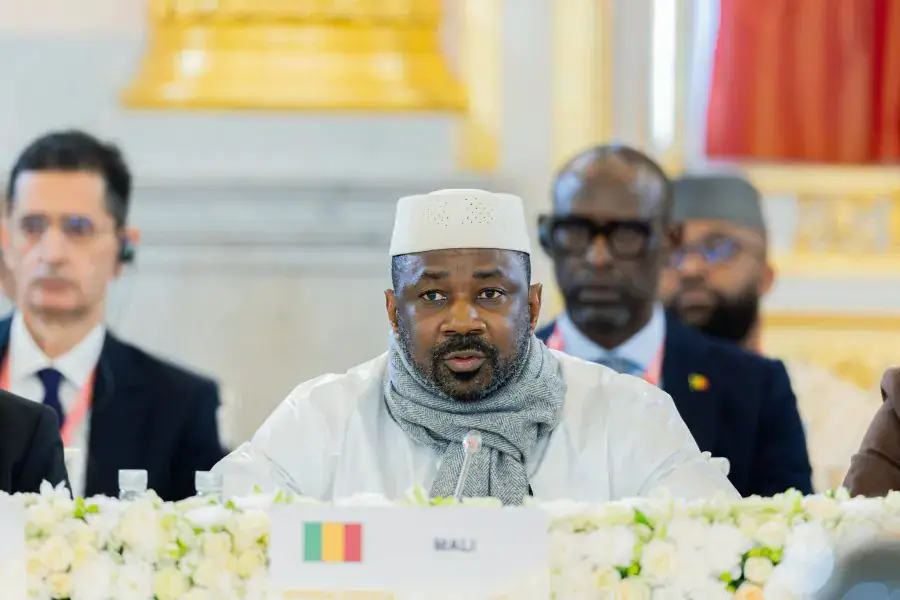
The 3rd Russia-Africa Summit, co-chaired by Russian President Vladimir Poutine and Burundian President Évariste Ndayishimiye, took place at the Grand Kremlin Palace. Mali's President Assimi Goïta delivered a speech focusing on sovereignty, a multipolar world order, and the review of Mali-Russia cooperation. The summit's central theme was "For Peace, Security, and Development." President Goïta emphasized that the current global context is marked by a shift in geopolitical balances, a return to a multipolar world, and an increasing aspiration for autonomy among nations.
President Goïta stressed that Africa cannot remain a mere theater of rivalries or a reservoir of raw materials. He advocated for the continent to assert itself as a stakeholder in global governance, free to make its own choices, alliances, and priorities. The President reviewed the past decade, noting that despite foreign military operations, the terrorist threat has continued to spread in the Sahel region. He justified Mali's shift towards relying on its own resources to defend its territory and protect its citizens.
The President highlighted the progress made by the Malian Armed Forces (FAMa) and the gradual return of central authority over the entire territory. He also denounced foreign-backed destabilization attempts and disinformation campaigns. President Goïta welcomed the launch of the AES Confederation's television channel, aimed at countering these efforts. He outlined his internal roadmap, which includes a new fundamental law based on state sovereignty, respect for the people's choices, and protection of vital interests.
On the economic front, President Goïta emphasized the importance of moralizing public life, administrative reform, and an endogenous model focused on valorizing national wealth and energy autonomy. He also highlighted the focus on human capital, declaring 2026-2027 as the Year of Education and Culture. The President discussed the AES Confederation, established with Burkina Faso and Niger, which aims to promote defense, diplomacy, and development cooperation.
President Goïta characterized Mali's partnership with Russia as loyal, balanced, and attentive to the needs of the population. He cited several examples, including Russian support for the Malian Armed Forces, food aid, and cooperation in the energy and infrastructure sectors. The President also mentioned the increase in scholarships for Malian students in Russia.
Russian President Vladimir Poutine positioned himself as a natural ally of Africa in the emergence of a multipolar world order, free from double standards. He highlighted the growth in bilateral trade, which exceeded $27 billion last year, a 50% increase since the previous summit. Poutine also noted the easing of customs barriers and the acceleration of de-dollarization in trade between Russia and Africa.
Burundian President Évariste Ndayishimiye, speaking on behalf of the African Union, emphasized the need for strategic and mutually beneficial investments. He clarified that Africa is not seeking charity but rather partnerships that can help the continent transform its resources, modernize its agriculture, and create local added value. The President of the African Union insisted on a major industrial paradigm shift, driven by the African Continental Free Trade Area (AfCFTA) and a dynamic youth population.
Key points
- President Assimi Goïta calls for a partnership based on equality and mutual respect between Mali and Russia.