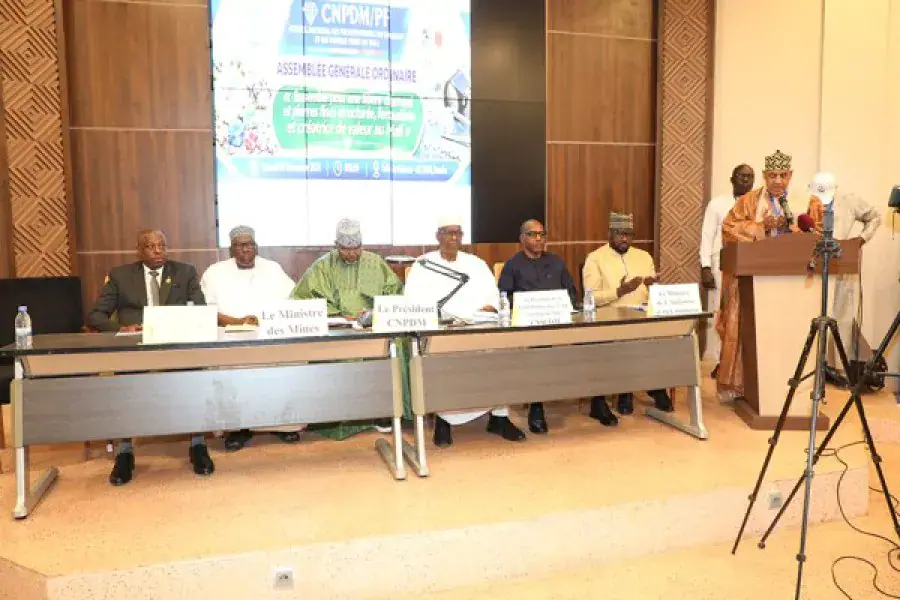
The diamond and precious stones sector in Mali has significant potential to become a source of wealth, but it faces numerous challenges. The sector is currently underdeveloped, with difficulties in exploitation, insufficient traceability, and commercialization constraints. To address these issues, the Conseil national des professionnels du diamant au Mali (CNPDM) is working to better organize stakeholders and formalize activities. The CNPDM recently held its ordinary general assembly, where it reviewed its activities, assessed challenges, and defined objectives for the next five years.
The assembly elected Bakary Koïta to a new five-year term as president of the CNPDM. Koïta emphasized the importance of transparency, member involvement, and credibility with authorities and partners. He called on professionals to prioritize collective interests, resolve differences through dialogue, and ensure accountability. The CNPDM, established in 2018, aims to federate sector stakeholders, defend their interests, and improve the sector's organization.
Despite progress, challenges persist in the sector. Zoumana Touré, head of the organization commission, highlighted the CNPDM's key missions, including producing reliable statistics and ensuring product traceability. He noted that efforts have been made to develop alluvial diamond exploitation in Yanfolila and Kéniéba, but accessing exploitation titles remains a significant challenge. This difficulty complicates the justification of stone origin and traceability, potentially undermining Mali's position within the Kimberley Process.
The CNPDM has set several objectives for its 2026-2031 mandate, including obtaining exploitation titles, reducing diamond export delays to under seven days, and preserving Mali's position in the Kimberley Process. The organization also aims to establish a cutting center in Bamako, formalize 1,000 artisanal miners, and host an international diamond salon. These goals reflect a desire to move beyond simple extraction and build a genuine industry around precious stones.
Amadou Sanoussi Daffé, president of the Confédération nationale des sociétés coopératives des orpailleurs du Mali, emphasized the importance of formalization in recognizing professionals and improving the sector's contribution to the national economy. He proposed cooperation between the CNPDM and his organization, particularly in training, cooperative structuring, and dialogue with public authorities.
The Malian government has expressed its willingness to support initiatives that strengthen the diamond sector. Soumaïla Siby, representing the minister of commerce and industry, assured that his department is available to accompany efforts to develop the sector. The government's support is crucial in addressing regulatory obstacles, enhancing transparency, and creating conditions for local transformation.
The diamond sector has the potential to generate employment, develop national skills, stimulate private investment, and increase public revenue. To achieve this, the sector must overcome its challenges and ensure that the wealth generated from Mali's natural resources benefits the national economy and population. The CNPDM's efforts to revitalize the sector and build a more formalized and transparent industry are a step in the right direction.
Key points
- The CNPDM aims to formalize 1,000 artisanal miners and establish a cutting center in Bamako.
- The organization seeks to reduce diamond export delays to under seven days.
- The sector's development could generate employment and stimulate private investment.
Reporting sources
- Diamant : Un secteur à structurer · Maliweb.net