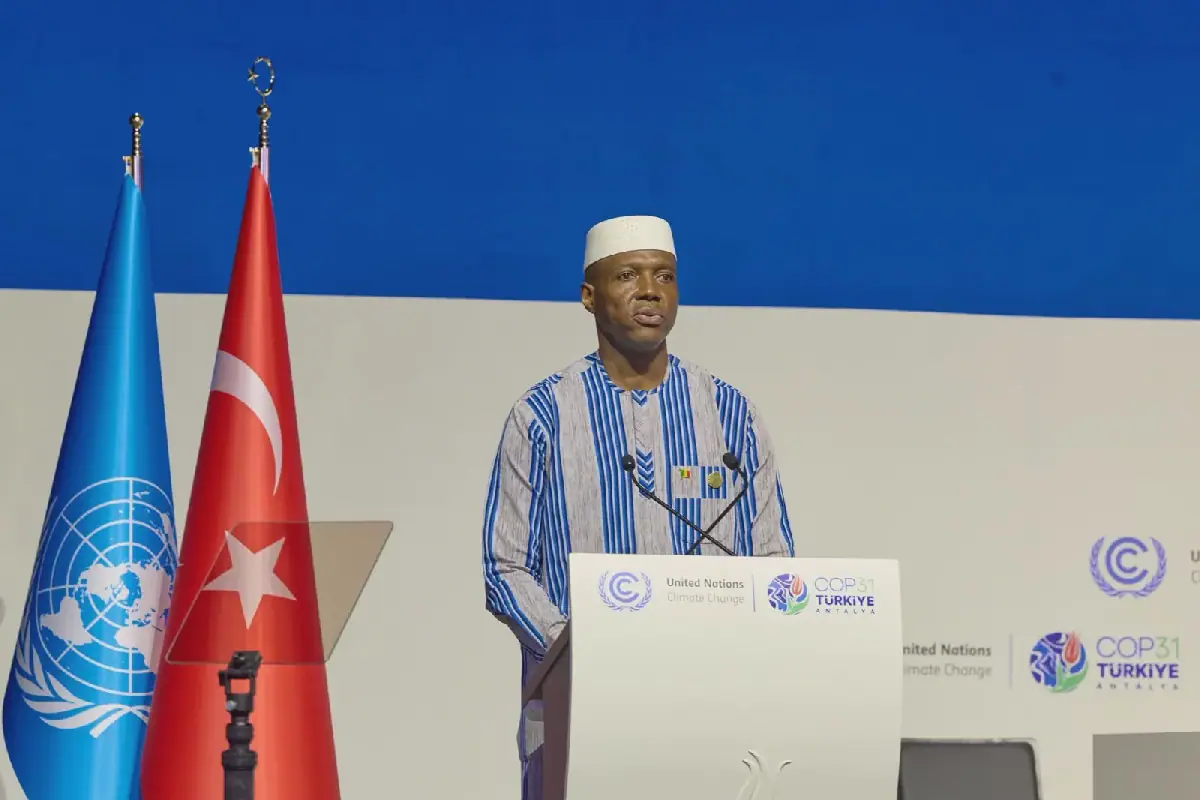
Mali's Prime Minister, General Abdoulaye Maïga, reaffirmed his country's commitment to fighting climate change at COP31 in Antalya, Turkey. He called on industrialized nations to take responsibility for their historical actions and meet their financial and environmental commitments. Maïga emphasized the need for concrete actions to improve the lives of vulnerable populations, highlighting Mali and the Sahel's challenges, including desertification, land degradation, and limited access to natural resources.
Maïga presented Mali's national ambitions, focusing on the "Mali Kura 2063" vision, which aims to build a sovereign, prosperous, and sustainable country. The "Yelen Kura" program plans to install 4,142 MWc of solar capacity to enhance the country's energy mix. This initiative could prevent the emission of 132 million tons of CO₂. Additionally, the updated Nationally Determined Contribution (NDC) 3.0, validated on October 1, 2026, targets a 25.25% reduction in greenhouse gas emissions by 2035.
The Malian government also aims to restore degraded lands and rehabilitate the Niger and Senegal rivers. On the issue of access to clean water, Maïga mentioned that 564 wells have been drilled over the past five years as part of the President of the Transition's social initiatives. He stressed the connection between climate, peace, and security in the Sahel, referencing the Bamako Declaration adopted in November 2023 and the development of a National Climate Security Strategy.
At the international level, Abdoulaye Maïga urged the most polluting countries to meet their commitments and accelerate emission reductions. He advocated for reforming the international financial system to better account for the vulnerability of developing countries. While reaffirming Mali's willingness to cooperate with its partners, Maïga insisted on respecting national sovereignty and the interests of the Malian people.
Maïga called for immediate action in the face of the climate emergency, stating, "We must act today and now to save the planet, because tomorrow will be too late." His speech underscored the importance of prioritizing concrete actions to address the climate crisis and its impacts on vulnerable populations.
The Prime Minister's participation in COP31 highlights Mali's commitment to addressing climate change and promoting sustainable development. Mali's efforts to enhance its energy mix, restore degraded lands, and improve access to clean water demonstrate its dedication to achieving its environmental ambitions.
As COP31 continues, Mali's advocacy for climate justice and environmental action serves as a reminder of the urgent need for collective action to address the global climate crisis. The country's initiatives and ambitions offer a model for sustainable development and climate resilience in the Sahel region and beyond.
Key points
- Mali aims to install 4,142 MWc of solar capacity to enhance its energy mix and reduce greenhouse gas emissions.
- The country targets a 25.25% reduction in greenhouse gas emissions by 2035.
- Mali's "Mali Kura 2063" vision aims to build a sovereign, prosperous, and sustainable country.