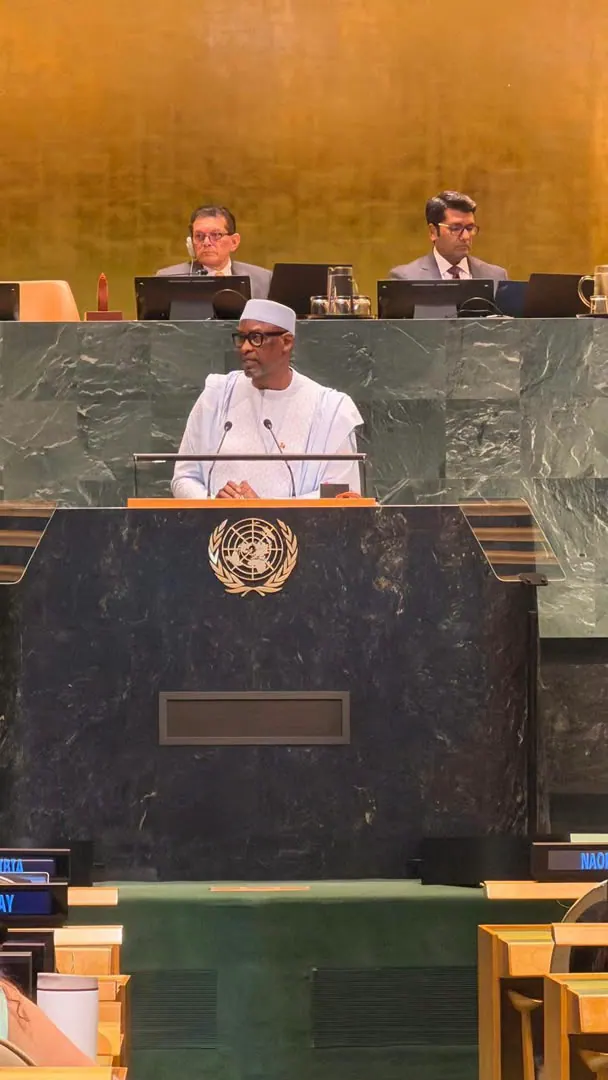
On September 29, Malian Foreign Minister Abdoulaye Diop addressed the 81st session of the United Nations General Assembly, calling for a reformed multilateral system based on sovereign equality, non-interference, and respect for territorial integrity. Speaking on behalf of Mali's transitional president, Assimi Goïta, Diop emphasized the need to restore trust among nations and adhere to the UN Charter principles. He also advocated for the lifting of unilateral coercive measures that harm national sovereignty and population welfare.
Diop's address highlighted the Sahel region's security situation, criticizing the 2011 NATO intervention in Libya for its consequences. He accused external actors of supporting terrorist groups in the region, specifically mentioning Ukraine. The minister's statements reflect Mali's stance on regional security and international relations. Furthermore, Diop defended the creation of the Alliance of Sahel States (AES), a cooperation framework between Mali, Burkina Faso, and Niger, focusing on security, politics, and economy.
In his speech, Abdoulaye Diop stressed the importance of economic sovereignty in Mali's national strategy. He emphasized mobilizing internal resources to achieve this goal. Diop reiterated Mali's support for the Palestinian people and expressed hope for an international order based on cooperation. His address outlined Mali's vision for a reformed multilateralism and strategic autonomy.
The AES, according to Diop, aims to enhance cooperation among member states in various areas. He sees this alliance as a crucial step toward achieving regional security and economic development. By strengthening ties with neighboring countries, Mali seeks to bolster its strategic autonomy and promote African cooperation.
Diop's call for a reformed multilateral system resonated with the UN General Assembly's theme of promoting international cooperation. He urged nations to work together to address global challenges, emphasizing the need for a more equitable and just international order. Mali's foreign minister also highlighted the importance of respecting national sovereignty and territorial integrity.
The Malian government's emphasis on strategic autonomy reflects its desire for self-reliance in security and development. By leveraging internal resources and regional partnerships, Mali aims to reduce its dependence on external actors. This approach is seen as essential for achieving sustainable development and ensuring national sovereignty.
In conclusion, Abdoulaye Diop's address to the UN General Assembly underscored Mali's commitment to reformed multilateralism and strategic autonomy. He reiterated the need for international cooperation, respect for national sovereignty, and the lifting of coercive measures. Mali's vision for a more equitable international order and regional cooperation in the Sahel region remains a key aspect of its foreign policy.
Key points
- Mali's Foreign Minister Abdoulaye Diop calls for a reformed multilateral system based on sovereign equality and non-interference.
- Diop advocates for the lifting of unilateral coercive measures that harm national sovereignty.
- Mali seeks to achieve strategic autonomy through regional cooperation and internal resource mobilization.