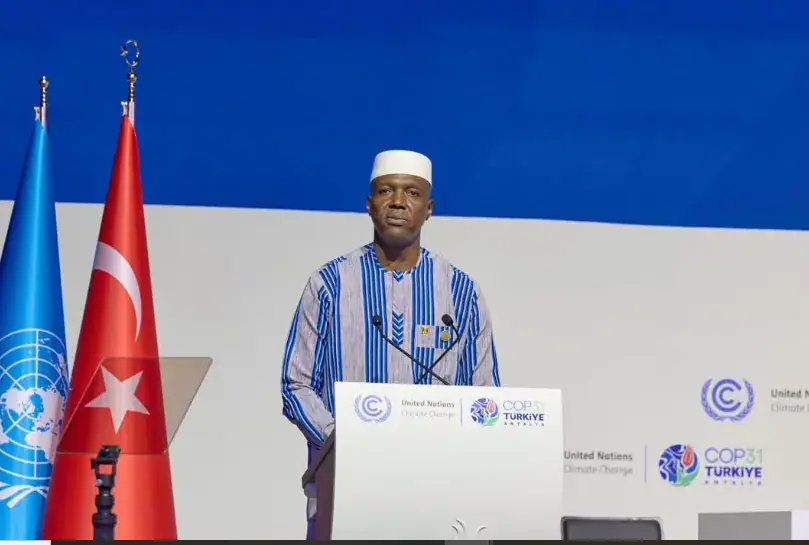
On November 12, 2026, at the COP31 Leaders' Summit in Antalya, Türkiye, Mali's Prime Minister Abdoulaye Maïga emphasized the need for climate justice. He called on major polluters to assume their responsibilities and honor their commitments. The Prime Minister highlighted Mali's initiatives to reduce greenhouse gas emissions and enhance population resilience to climate change. He stressed the importance of transitioning from commitments to concrete actions to address the concerns of populations affected by climate change.
Maïga underscored the vulnerability of Mali and other Sahel region countries, which face desertification, land degradation, and the consequences of climate change on livelihoods. He also emphasized the links between climate, peace, and security in a region already impacted by terrorism. The Prime Minister presented several national initiatives, including the "Yelen Kura" energy program, which aims to install 4,142 megawatts of solar capacity, reducing CO2 emissions by an estimated 132 million tons over the installations' lifespan.
Mali's third Nationally Determined Contribution (CDN 3.0), validated on October 1, 2026, sets a target to reduce greenhouse gas emissions by 25.25% by 2035, compared to reference projections, in the energy, agriculture, and waste sectors. Maïga specifically addressed major polluters, emphasizing that populations with minimal contribution to the climate crisis should not bear the brunt of its consequences, given their limited financial and technological resources.
The Prime Minister urged respect for international commitments and reform of the global financial architecture to account for the climate vulnerability of developing countries. He argued that protecting populations should not be compromised by debt burdens. Maïga reaffirmed Mali's willingness to cooperate with partners while respecting its sovereignty.
Maïga concluded by emphasizing the urgency of action, stating that "we must act today and now to save the planet, for tomorrow will be too late." He called for concrete responses to the concerns of populations affected by climate change, as COP31 negotiations continued until November 20, with climate financing at the center of discussions.
The COP31 Leaders' Summit brought together global leaders to address pressing climate issues. Mali's participation and contributions to the summit reflect the country's commitment to addressing climate change and promoting sustainable development. As a key player in the Sahel region, Mali's experiences and perspectives are essential in shaping global climate policies.
The international community has been urged to support Mali and other developing countries in their efforts to address climate change. This includes providing financial and technological assistance to help countries adapt to the impacts of climate change and transition to low-carbon economies. The outcome of COP31 will be crucial in determining the future of global climate action and cooperation.
Key points
- Mali's Prime Minister Abdoulaye Maïga calls for climate justice and urges major polluters to take responsibility for their actions.
Reporting sources
- COP31 : le Mali plaide pour une justice climatique et présente ses ambitions · Le Journal du Mali