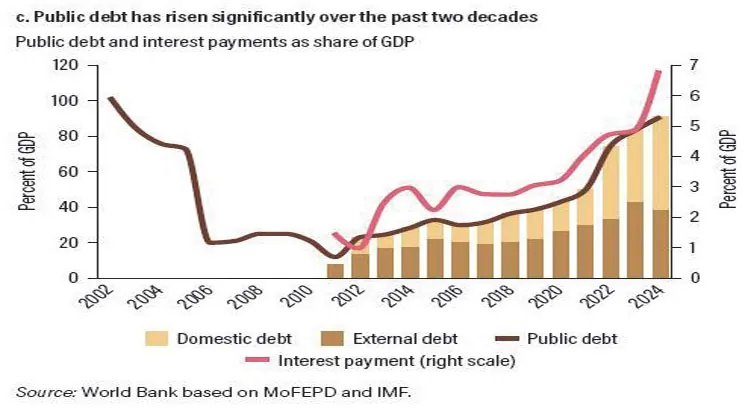
The Malawian government is at high risk of a new debt default due to slow progress in restructuring its external commercial debt, according to a report by global credit insurance firm Coface. The firm's risk analysis for Malawi notes that domestic debt, which accounts for about 60 percent of total public debt, is growing as the government increasingly turns to the domestic market. This shift comes after Malawi defaulted on external commercial creditors, including the Trade and Development Bank and the African Export-Import Bank.
Coface, a French firm founded in 1947, offers credit insurance, debt collection, and business information worldwide. The firm observed that Malawi is turning to the domestic banking market to borrow, despite high interest rates of around six percent real yield on average at three-year maturity. The Reserve Bank of Malawi holds 30 percent of domestic debt. Following a partial restructuring in 2024, bilateral debt is now low, at eight percent of external debt, primarily owed to China Exim Bank.
In its analysis, Bank of Scotland noted that over 60 percent of Malawi's external debt is multilateral and not subject to restructuring. This development poses significant challenges to the country's debt restructuring efforts. In November 2023, the International Monetary Fund said Malawi's efforts to stabilize its economy would be in vain unless the country secures debt forgiveness on $976 million owed to commercial and bilateral creditors.
The Reserve Bank of Malawi reported that about K1.27 trillion owed under facilities with the Trade and Development Bank and Egypt-based Afreximbank stood in arrears at the end of 2025. Negotiations to restructure the debt have been ongoing for years. United Kingdom-based global affairs think-tank ODI Global noted that Malawi, alongside Zambia and Ghana, is finding it difficult to finalize debt restructuring negotiations with Afreximbank and TDB.
Economist Velli Nyirongo observed that arrears affect the country's creditworthiness and standing with investors, potentially leading to higher borrowing costs and more limited access to future external financing. The Ministry of Finance, Economic Planning and Development reported that Malawi's total public debt stock stood at K24.33 trillion as of end-December 2025, up from K19.18 trillion at end-March 2025.
The increase in nominal public debt was accompanied by a rise in the debt-to-gross domestic product ratio from 91.5 percent to 93.2 percent over the same period. The Treasury attributed the increase in total public debt to domestic borrowing, reflecting ongoing fiscal financing requirements and constrained access to concessional external financing.
Minister of Finance, Economic Planning and Decentralisation Joseph Mwanamvekha stated that Malawi's path towards managing public debt is constrained by current stock levels. However, he noted that the fiscal plan estimates were formulated on the basis that debt restructuring will create fiscal space. The country's debt situation remains a pressing concern, with significant implications for its economic stability.
Key points
- Malawi's debt default risk is rising due to slow progress in restructuring external commercial debt.
- The country's domestic debt is growing, driven by high interest rates and constrained access to concessional external financing.
- Debt restructuring efforts are crucial to creating fiscal space and stabilizing the economy.