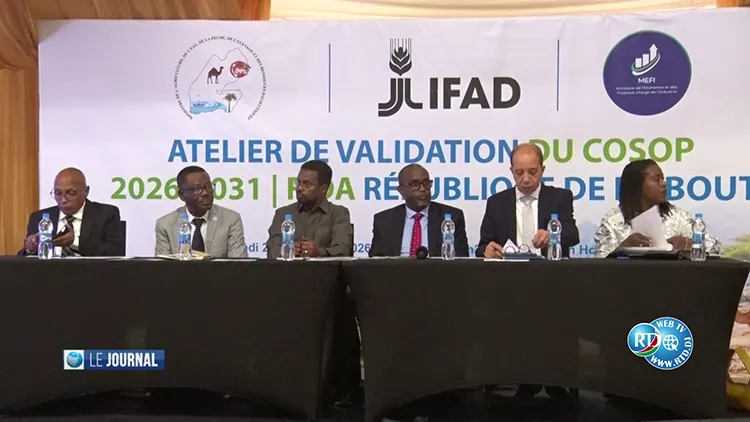
The Ministry of Agriculture, Water, Fisheries, Livestock, and Halieutic Resources in Djibouti recently organized a workshop to validate the country's Strategic Options Program (COSOP) for 2026-2031. The event, held at the Sheraton Hotel in Djibouti, was attended by representatives from the Djiboutian government, the United Nations system, and the International Fund for Agricultural Development (IFAD). IFAD is the technical and financial partner for this new five-year program. The workshop aimed to bring together stakeholders to discuss and validate the program's objectives and strategies.
The workshop's opening session featured a series of speeches from various dignitaries. The IFAD Country Director was the first to take the stage, followed by the representative of the United Nations system in Djibouti and the IFAD Regional Director. The Secretary General of the Ministry of Economy and Finance in charge of Industry also delivered a speech before the official opening address by Minister Abdillahi Ahmed. The minister's speech set the tone for the workshop, emphasizing the importance of the COSOP in guiding cooperation between IFAD and Djibouti.
During the workshop, the IFAD Country Director reviewed the key lessons learned from the implementation of the previous COSOP. She also outlined the objectives assigned to the validation meeting. The Secretary General of the Ministry of Agriculture presented the main orientations retained for the COSOP 2026-2031, as well as the expected results of this new cooperation cycle. These presentations occupied the majority of the morning session, followed by a family photo and a coffee break.
The COSOP serves as the strategic framework that guides IFAD's cooperation with Djibouti in the sectors of agriculture, fisheries, livestock, and water management for a period of five years. The program aims to define intervention priorities to strengthen food security and the incomes of rural and coastal populations in the country. Djibouti's cooperation with IFAD focuses on improving the livelihoods of its citizens, particularly in rural areas.
The workshop brought together a diverse range of stakeholders, including government officials, representatives from the United Nations system, and IFAD experts. The event provided a platform for participants to discuss and validate the COSOP's objectives, ensuring that they align with Djibouti's national priorities and IFAD's strategic goals. The active participation of stakeholders is crucial for the successful implementation of the program.
The validation of the COSOP 2026-2031 is a significant milestone in Djibouti's cooperation with IFAD. The program's implementation is expected to have a positive impact on the country's agricultural sector, contributing to improved food security and increased incomes for rural communities. The workshop's outcome will inform the finalization of the COSOP, which will guide IFAD's support to Djibouti over the next five years.
The Ministry of Agriculture, Water, Fisheries, Livestock, and Halieutic Resources in Djibouti is committed to implementing the COSOP 2026-2031, in partnership with IFAD and other stakeholders. The successful implementation of the program will require close collaboration and coordination among all parties involved. The workshop's conclusions and recommendations will inform the finalization of the COSOP, ensuring that it meets the needs of Djibouti's rural and coastal populations.
Key points
- The Djiboutian government, the United Nations system, and IFAD are collaborating on the COSOP 2026-2031 to strengthen food security and incomes of rural and coastal populations.