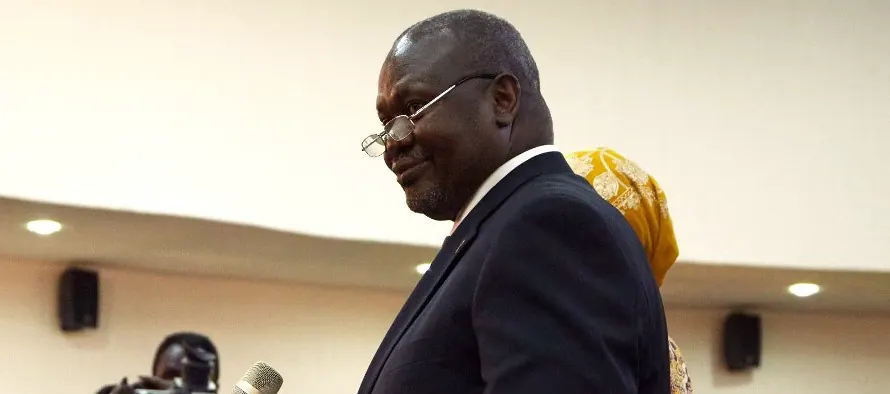
Former South Sudan First Vice President Riek Machar has accused the prosecution and other officials of turning his ongoing trial into a political process intended to settle political differences. Machar made the accusation during the 120th session of the Special Court in Juba, as he continued presenting his defence in the case involving him and seven co-accused over violence in Nasir, Upper Nile State, in March 2025. The defendants face charges including treason, murder, conspiracy, terrorism, destruction of public property and crimes against humanity.
Prosecutors allege that forces aligned with Machar’s Sudan People’s Liberation Movement/Army in Opposition (SPLM/A-IO), together with the White Army militia, attacked a government military garrison in Nasir and killed 257 South Sudan People’s Defence Forces (SSPDF) soldiers, including commander General David Majur Dak. The prosecution has also alleged that military equipment worth about $58 million was destroyed or seized during the fighting. Machar and the other defendants have denied the charges.
Machar expressed concerns about a series of court rulings that had raised questions about the fairness and independence of the proceedings. He questioned the role of private advocates who have been involved in the prosecution, arguing that government prosecutors from the Ministry of Justice and Constitutional Affairs had taken a back seat while co-opted advocates had assumed a leading role. Machar asked whether co-opted advocates are members of the National Security Service who had been assigned to prosecute the case on behalf of the complainant.
Machar challenged several previous court decisions, including rulings concerning audio-visual recording of proceedings, defence access to accused persons, media coverage, the court’s jurisdiction, presidential immunity and his designation as the fifth accused. He argued that the case should remain a prosecution by the state against him and his co-accused, rather than becoming what he called “a case of private advocates against the FVP and co-accused.”
Machar also challenged the court’s ruling concerning its jurisdiction in relation to the proposed Hybrid Court for South Sudan and the supremacy of the Revitalized Agreement on the Resolution of the Conflict in South Sudan (R-ARCSS). The court had previously ruled that it had jurisdiction to hear and try Machar and his seven co-accused after the defence challenged its authority, including on grounds relating to Machar’s immunity as first vice president.
The 74-year-old chairman of the SPLM-IO argued that decisions of the court should not be influenced by what others write on social media. He also alleged that the ruling concerning the government’s authority to investigate mass violations was politically motivated. Machar said the court’s decision was contrary to provisions of the R-ARCSS and the amended Constitution.
Machar’s trial has raised concerns about the fairness and independence of the judicial process in South Sudan. The case has been ongoing since October 7, 2026, and Machar has denied all charges against him. The trial's outcome may have significant implications for the country's fragile peace process.
Key points
- Machar claims his trial is politically motivated.
- The trial involves charges of treason, murder, and crimes against humanity.
- Machar challenges several court rulings, citing concerns about fairness and independence.