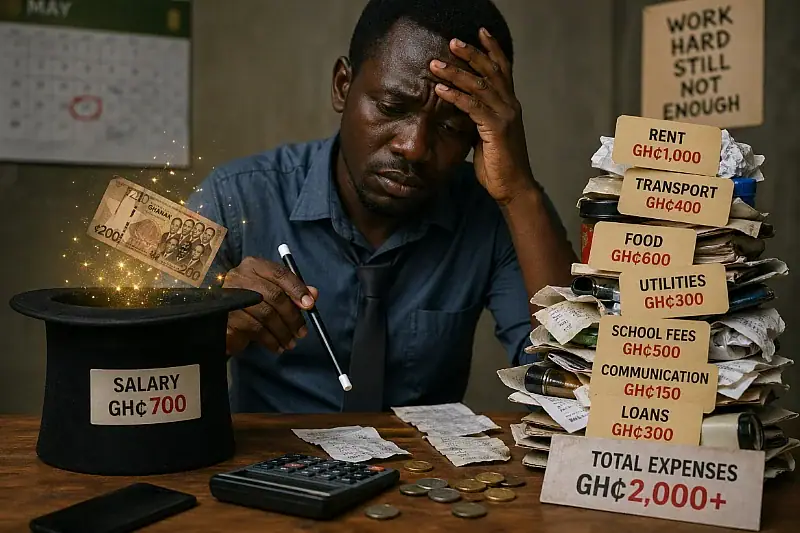
Low-income earners in Accra are finding it impossible to save due to a combination of factors, including high housing costs, low wages, and a financial system that offers limited incentives to keep money in a bank account. For a single mother earning GH¢1,000 a month, the landlord demands GH¢800 monthly, paid two years in advance, which is GH¢19,200 before she gets the keys. This leaves her with no option but to borrow or rely on family to raise the lump sum.
The rent trap is a significant barrier to saving for low-income earners in Accra. Landlords routinely demand one to two years' rent upfront, a practice that is illegal under the Rent Act of 1963 but has become the market norm. Tenants borrow at high interest, sell assets, or rely on family to raise the lump sum, and the period that follows is spent repaying the loan, not building savings. Agent fees add another 10% of the total advance, and when the lease comes up for renewal, landlords adjust the price upward and demand another two-year lump sum at the new rate.
The pay gap is another significant challenge facing low-income earners in Accra. A study led by Professor Smart Sarpong of Kumasi Technical University found that only 32.2% of salaried workers can save, citing inadequate pay as the primary reason. More than 36% of workers earn below GH¢1,000 a month, and in the private sector, 15.8% earn below that threshold, compared to 6.6% in the public sector. The national daily minimum wage is GH¢21.77, yielding roughly GH¢565 gross per month.
The financial system in Ghana also offers weak incentives to formalize savings. For years, inflation outpaced savings rates, making it more beneficial to spend money quickly rather than save it. However, by February 2026, inflation had fallen to 3.3%, while commercial bank savings rates remained around 5%, giving depositors a positive real return of about 1.7 percentage points. Despite this shift, access to bank accounts remains a significant challenge for low-income earners.
Research using Ghana Living Standards Survey data found that bank account ownership is the single most important predictor of formal saving, raising the probability of saving by 55.1 percentage points. Education's effect on saving operates almost entirely through access to a bank account. For low-income earners without accounts, or with accounts that carry maintenance fees and minimum balance requirements, the formal system remains distant.
Mobile money has expanded access to financial services, but its impact on saving is uneven. A study of petty traders in Accra Central found that those with higher monthly incomes were more likely to use mobile money for saving, while those with lower incomes were less likely to save through the platform at all. The technology lowers barriers, but it does not create surplus.
The inability to save is not a personal failing, but rather the predictable outcome of a system where the largest expense - housing - demands a lump sum that wages cannot produce, where wages themselves are set at levels that assume survival rather than security, and where the financial system's recent improvement in real returns is too small and too new to change behavior. For millions of low-income earners in Accra, saving requires something left over, but there is nothing.
Key points
- Only 32.2% of salaried Ghanaian workers can save, while 67.8% report that their monthly expenditure exceeds their income.
- A modest monthly existence in Accra requires GH¢4,000-8,000, according to cost-of-living estimates.
- Bank account ownership is the single strongest predictor of saving, raising the probability of saving by 55.1 percentage points.