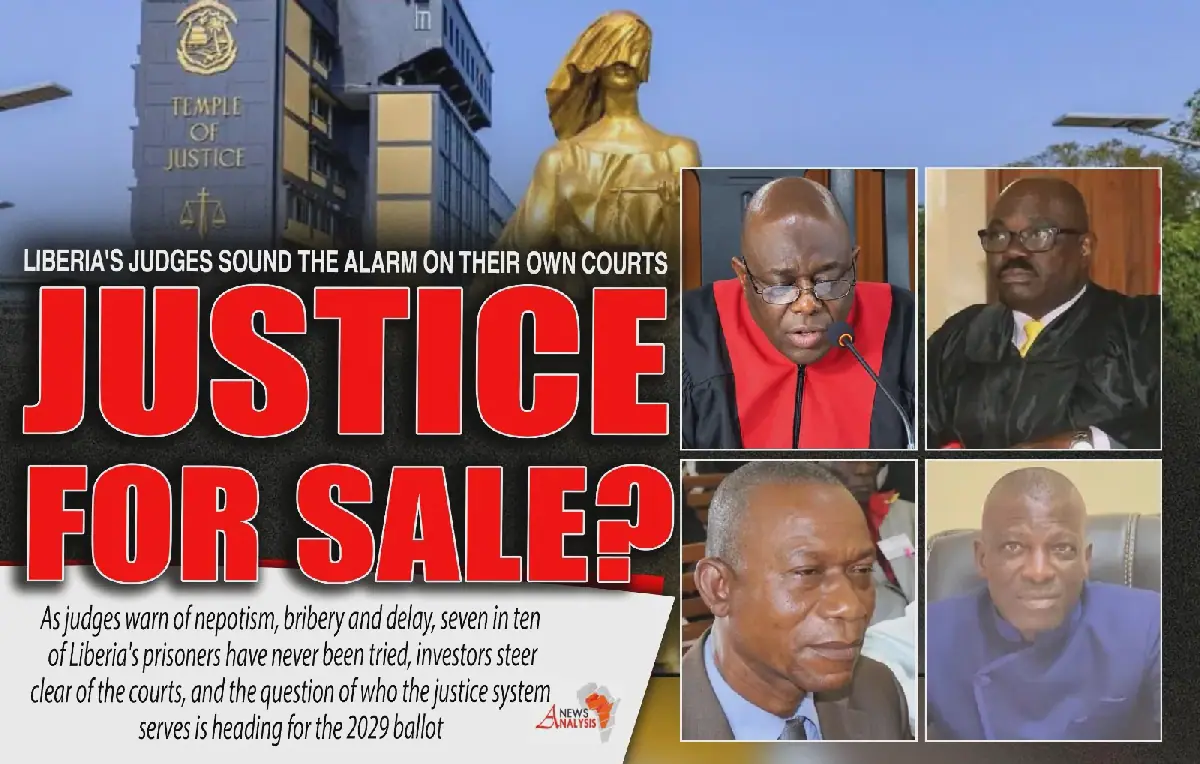
Liberia's judges have sounded the alarm on the state of the country's justice system, warning that corruption, favouritism, political interference, and delay are eroding public trust in the courts. In their formal addresses at the opening of the November 2026 court term, several circuit judges highlighted the need for reform. They noted that the problems faced by ordinary Liberians are not high-profile trials, but rather waiting for hearings, lawyers, judges, and rulings, often without the money to expedite the process.
The judges' comments are based on their own experiences and observations. In Zwedru, Circuit Judge J. Kennedy Peabody defined corruption as filling state jobs with relatives and fellow tribesmen, and punishing staff who disagree. He emphasized that no one is above the Constitution, including judges. In Monrovia, Judge Roosevelt Z. Willie questioned whether Liberia had learned from its past failures, citing a 2006 report that listed corruption, unqualified judicial staff, poor pay, and the influence of money and politics in the justice system.
The statistics on the state of Liberia's prisons support the judges' concerns. As of September 2026, 2,848 of the 4,125 people held in Liberia's prisons, or about 69 per cent, had never been tried. Some had not even been indicted. At Monrovia Central Prison, 1,312 of roughly 1,888 inmates were awaiting trial. The U.S. State Department's human rights report on Liberia found that about 60 per cent of pretrial detainees were held for more than two terms of court, or roughly 180 days, without a hearing.
The problems in the justice system have significant consequences for ordinary Liberians. For those who cannot afford lawyers or bonds, relief often comes from charity rather than the state. In October, a legal aid clinic secured the release of 63 pretrial detainees from Monrovia Central Prison through the judiciary's Magistrate Sitting Program. The same pattern is seen in everyday disputes over debts, wages, and land, with less than a quarter of Liberia's land formally registered.
The public has taken notice of the problems in the justice system. Afrobarometer found that 52 per cent of Liberians see widespread corruption among judges and magistrates. The Bertelsmann Transformation Index reports that Liberians widely see their courts as serving the rich, and that influence peddling regularly decides cases. The judges' warnings point upward, to the Supreme Court and the leadership of the judiciary.
Chief Justice Yamie Quiqui Gbeisay took office in August 2025, promising to tackle inefficiency, corruption, and malpractice in the courts. However, more than a year later, judges in his own system are saying publicly that those problems persist. The clearest test of the Court's authority remains unresolved, with the Supreme Court yet to rule on whether its own order was defied in the case of expelled lawmaker Yekeh Kolubah.
The judges' concerns have implications for the rule of law and public trust in Liberia. If the country's highest court cannot make its own orders stick with the Legislature, what chance does a market trader have of enforcing a judgment against a well-connected landlord? The judges' warnings highlight the need for reform and accountability in the justice system, and for the government to take concrete steps to address the problems faced by ordinary Liberians.
Key points
- Liberia's judges are warning of widespread corruption and delay in the justice system.
- The problems in the justice system disproportionately affect the poor, who cannot afford lawyers or bonds.
- The Supreme Court's authority has been called into question by its failure to rule on a key case.
Reporting sources
- Liberia’s Judges Sound the Alarm on Their Own Courts · FrontPage Africa