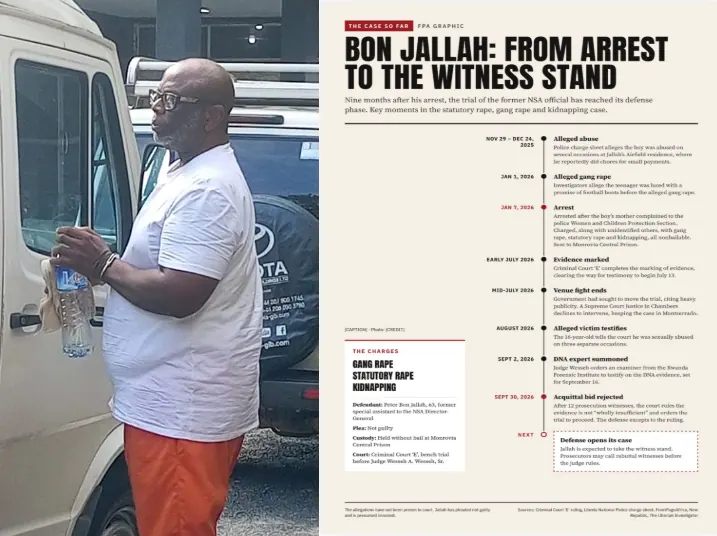
In a recent ruling, Judge Wesseh Alphonsus Wesseh, Sr. of Criminal Court "E" in Monrovia, Liberia, denied a motion by Peter Bon Jallah's lawyers to acquit their client before trial. The 63-year-old is accused of gang rape, statutory rape, and kidnapping of a 16-year-old boy. Jallah has denied the charges and opted for a trial by judge alone, without a jury. The prosecution presented 12 witnesses, including the alleged victim, police investigators, medical staff, and a forensic expert from Rwanda.
To win the motion, the defense had to show that the prosecution's evidence was "wholly insufficient," a standard set by the Supreme Court in Republic of Liberia v. Robert A. Smith in 1976. However, the judge ruled that the prosecution had produced enough evidence for the defense to answer the charges. The prosecution did not have to prove guilt beyond a reasonable doubt at this stage but only had to show evidence on each element of the charges. The defense argued that the prosecution's evidence was insufficient, but the judge disagreed.
One of the key issues raised by the defense was the alleged crime scene on Camp Johnson Road. The alleged victim testified that he was taken to this location and sexually abused, but the defense pointed out that police could not find or identify the location. A woman the boy claimed to have encountered there was never produced in court. The judge declined to throw out this part of the testimony, but the issue remains a challenge for the prosecution.
The defense also highlighted discrepancies between the alleged victim's testimony and the police charge sheet regarding the dates and places of alleged encounters at Jallah's home in Airfield. The defense argued that these inconsistencies raised doubts about the prosecution's case. However, courts have often taken into account that traumatized witnesses may not provide precise directions or recall exact dates.
Medical evidence presented in court showed that the alleged victim had lacerations and bruises, but the defense argued that this did not necessarily prove rape. The DNA evidence, analyzed by a Rwandan expert, also raised questions about what it could prove and what it could not. The defense complained about the limits of the scientific evidence, but it did not argue that the DNA found no link at all.
The charge of gang rape suggests that there may be other perpetrators involved, but the judge's ruling did not mention anyone else. The defense is expected to press hard on this question during the trial. Jallah's lawyers also argued that the indictment was flawed, but the judge ruled that this objection came too late and should have been raised in a motion to dismiss before the trial began.
Jallah is expected to take the stand as the defense's first witness, which could be a crucial moment in the trial. His lawyers will have the opportunity to present their case, but they also risk exposing their client to cross-examination by prosecutors. The prosecution has said it may call rebuttal witnesses after the defense rests, and the judge has ordered the trial to proceed "unhindered." The defense has excepted to the judge's ruling and may appeal the decision.