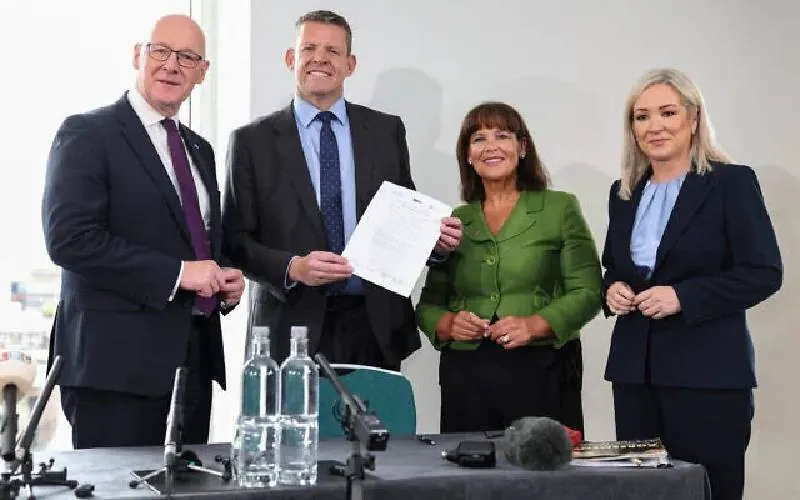
The leaders of Scotland, Wales and Northern Ireland have signed a joint agreement in Cardiff, declaring their right to self-determination and their shared pursuit of independence from the United Kingdom. The agreement was signed on September 14, 2026, by John Swinney of the Scottish National Party, Rhun ap Iorwerth of Plaid Cymru and Michelle O'Neill of Sinn Fein. They stated that no Westminster government has the right to block democracy or undermine the principle that their people will decide their own future.
The joint agreement has drawn attention and support across former British colonies in Africa, where the sight of Westminster refusing to authorise a referendum carries a particular weight. In Kenya, it brings back the memory of a struggle that lasted nearly eighty years and cost thousands of lives before independence was finally conceded in 1963. Kenya's path to independence was among the most difficult, with British influence in the region established through the Imperial British East Africa Company in 1888.
After the Second World War, the British Empire began to break up, and the 1956 Suez Crisis exposed Britain’s financial and military weakness, destroying much of its remaining influence in the Middle East. The withdrawal from India and Pakistan in 1947 marked the beginning of a sustained period of decolonisation, and the same fiscal reality that made empire untenable abroad now shapes the debate over the union at home. The 1960s saw a wave of independence across British Africa, with 17 sub-Saharan African countries gaining sovereignty in 1960 alone.
Kenya’s struggle for independence was marked by the emergence of the Kenya African Union in 1946, which failed to bring reform. In 1952, the Mau Mau Uprising began when the Kenya Land and Freedom Army launched a campaign against colonial authorities. The British declared a State of Emergency and launched a counterinsurgency campaign that mixed military action with widespread detention and land seizures. The response disintegrated into systemic brutality, with tens of thousands of suspected guerrillas detained in overcrowded labour camps.
The Mau Mau uprising and its associated violence convinced Britain of the need for reform, and on December 12, 1963, Kenya became independent under the Kenya Independence Act. Jomo Kenyatta, one of the Kapenguria Six arrested, tried and imprisoned by the British, became the first Prime Minister. However, the end of colonial rule did not end colonial control, and the British Army Training Unit Kenya continues to operate in Laikipia and Samburu counties, a military presence that outlasted the empire that created it.
The Kenyan case demonstrates that independence is achieved through sustained pressure, organised movements and the willingness to endure repression until the colonial power concludes that reform is unavoidable. Kenyans are pursuing accountability for British soldiers who have committed documented crimes on Kenyan soil with impunity, and Kenyan courts still cannot hold them to account because Britain has refused to amend the Defence Cooperation Agreement to grant them jurisdiction.
The Cardiff agreement echoes a history of Pan-Africanist solidarity with anti-colonial struggles, and the joint declaration stated that "for people watching around the world, there could be no clearer sign" of the determination of the people of Scotland, Wales and Northern Ireland to decide their own future. The agreement has sparked interest and debate across the globe, with many drawing parallels between the struggles for independence in different parts of the world.
Key points
- The joint agreement signed by Scotland, Wales and Northern Ireland declares their right to self-determination and pursuit of independence from the UK.
- Kenya's path to independence was marked by a long and difficult struggle, with the Mau Mau Uprising playing a key role in convincing Britain of the need for reform.
- The end of colonial rule does not necessarily end colonial control, as seen in the continued presence of British soldiers in Kenya.