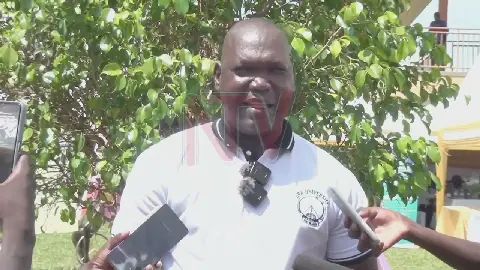
A mathematician from Lesotho is working on a project that could potentially improve cancer treatment. Likhang Thethe, 24, holds a mathematics degree and a Bachelor of Science Honours in Applied Mathematics from the National University of Lesotho. He is investigating how cancer cells respond to oncolytic viruses, which are used to target and kill cancer cells. Thethe's research aims to understand why some cancer cells survive treatment while others die. His work is being conducted in the university's Department of Mathematics and Computer Science.
Thethe's research examines viral treatment, cancer-cell resistance, and the Allee effect, a biological concept that describes how a population may struggle to survive or grow when its numbers become too low. Using equations and computer simulations, he examines how cancer cells and viruses interact and how different treatment conditions could affect tumour growth and resistance. Thethe's simulations suggest that stronger viral infection could reduce the number of cancer cells susceptible to treatment but may also allow resistant cells to grow.
However, Thethe's simulations also indicate that a sufficiently strong Allee effect could cause resistant cancer cells to die out if their population falls below a critical threshold. Thethe stressed that these findings are mathematical predictions rather than proven clinical results. His work remains at the modelling and computer simulation stage, and further laboratory research and biological data would be needed to establish whether the predictions reflect what happens in actual cancer treatment.
Thethe identified several challenges in his research, including representing the complexity of cancer using mathematical equations, especially when biological data are limited. He said collaboration with cancer researchers, access to reliable data, and research funding would help advance the work. Thethe hopes his research could eventually contribute to a better understanding of oncolytic virus therapy and help researchers explore treatment strategies, although the model is not yet suitable for guiding patient care.
Thethe believes that his work demonstrates how researchers in Lesotho and across Africa can contribute to global health challenges through mathematics and computational science. His research has the potential to make a significant impact in the field of cancer treatment. Thethe's next steps include refining the model, testing how changes in its parameters affect the results, and comparing its predictions with experimental data.
Thethe's long-term goal is to work with biological and medical researchers to explore whether the findings can support future cancer-treatment research. He aims to refine his model and make it more accurate, which could lead to the development of more effective cancer treatments. Thethe's research is an example of how mathematical modelling can be used to tackle complex biological problems.
Thethe's work is a significant contribution to the field of cancer research, and his findings have the potential to improve our understanding of cancer treatment. His research highlights the importance of interdisciplinary collaboration and the need for further research in this area. Thethe's work is an exciting development in the field of cancer treatment, and it will be interesting to see how his research progresses in the future.
Key points
- Thethe's research uses mathematical equations and computer simulations to understand cancer cell response to oncolytic viruses.
- Thethe's simulations suggest that stronger viral infection could reduce the number of cancer cells susceptible to treatment but may also allow resistant cells to grow.
- Thethe's long-term goal is to work with biological and medical researchers to explore whether the findings can support future cancer-treatment research.