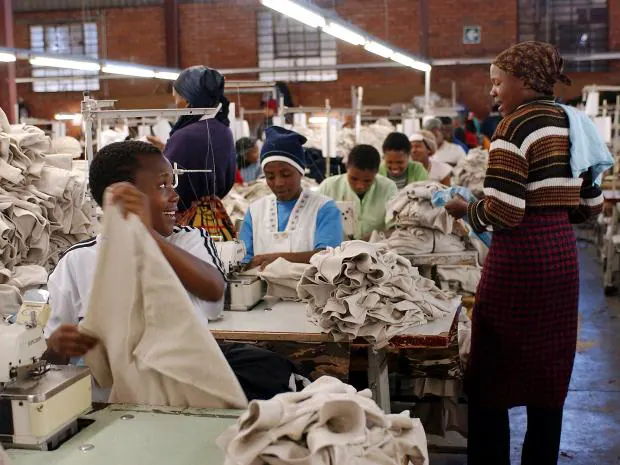
The Lesotho government has set ambitious targets to revive the country's struggling textiles and apparel industry. By 2033, the government aims to create over 70,000 jobs, generate more than $1 billion in annual exports, and attract over $400 million in new investment. These targets are part of the country's new Textiles and Apparel Sector Strategy, which was recently validated in a workshop in Maseru.
The strategy seeks to transform the industry from basic assembly to higher-value manufacturing, diversify export markets, and increase local processing of Lesotho's wool and mohair. According to Monaheng Monaheng, Director of the One Business Stop Facilitation Centre in the Ministry of Trade, textiles and apparel have been at the heart of Lesotho's manufacturing economy for over three decades, employing over 40,000 people at its peak.
However, the industry has suffered significant losses since the Covid-19 pandemic, compounded by uncertainty surrounding the African Growth and Opportunity Act (AGOA). Employment has declined to lower than 30,000, and the industry's heavy dependence on the US market has made it vulnerable to changes in American trade policy. The US recently extended AGOA until 2028, providing some relief to manufacturers.
Lesotho National Development Corporation (LNDC) Chief Executive Officer, Thabo Khasipe, believes the industry has the capacity to recover. He emphasizes the need for a fundamental change in the way Lesotho approaches the industry, including reducing reliance on imported fabric and increasing the use of locally produced fibre. The new strategy aims to increase the share of textile and apparel exports going to markets outside the US to 55%.
The strategy also seeks to move more than one-third of production from cut-make-and-trim operations to full-package manufacturing, while increasing the proportion of Basotho in management positions to 40%. Additionally, the government targets domestic processing of at least 20% of the country's wool and mohair, creating opportunities in testing, scouring, spinning, knitting, weaving, design, and branding.
Implementation of the strategy will be crucial to its success, according to CAFI Managing Director, Chaba Mokuku. He emphasizes that the strategy should no longer be regarded as the property of development partners or individual institutions, but rather as a sector strategy owned by all stakeholders. The strategy will be implemented in three phases: diversification to 2028, expansion to 2031, and consolidation from the seventh year onwards.
The success of the strategy will depend on the participation of textile companies, which are urged to sign memoranda of understanding with LNDC to take advantage of programmes designed to improve operational efficiency and productivity. The government, LNDC, and development partners will work together to monitor implementation, with progress reviewed quarterly and reported through the Public-Private Dialogue Forum.
Key points
- Lesotho aims to create 70,000 textile jobs and generate $1 billion in exports by 2033
- The strategy seeks to diversify export markets and increase local processing of wool and mohair
- Implementation of the strategy will depend on the participation of textile companies and government support