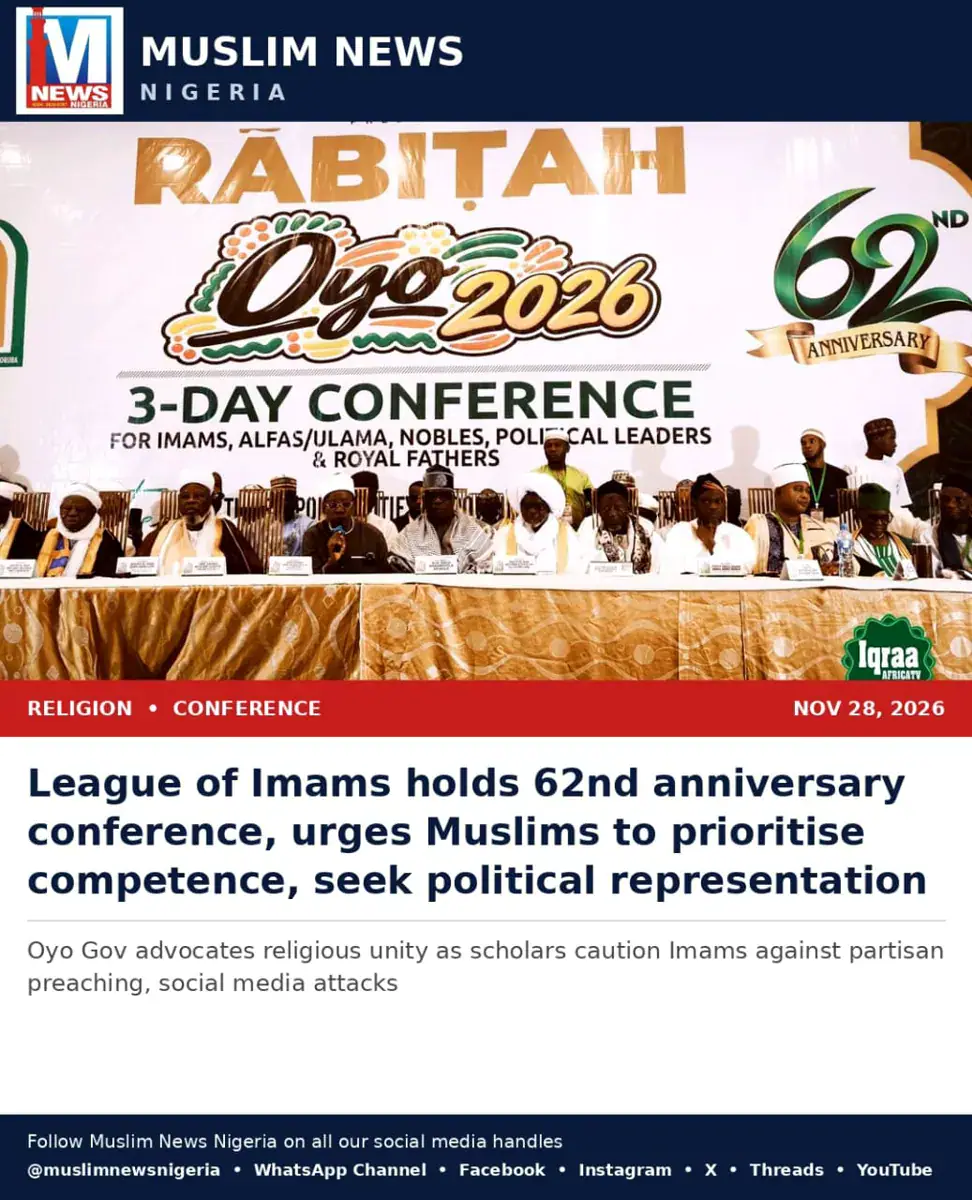
The League of Imams and Alfas in Yorubaland, Edo and Delta States recently held its 62nd anniversary conference, themed “The Responsibilities of Politicians and Electorates During and After the Electoral Process.” The three-day gathering, which took place from November 14 to 16, 2026, at Jogor Event Centre in Ibadan, Oyo State, brought together Islamic scholars, traditional rulers, political leaders and stakeholders from across the country. The conference aimed to examine the responsibilities of politicians and electorates before, during and after elections, alongside issues of Muslim unity, religious leadership, peaceful coexistence and good governance.
Emeritus Professor of Arabic, Razaq ‘Deremi Abubakre, delivered the keynote address, emphasising that Islam is not opposed to politics. He urged Muslims to take an active interest in governance and seek equitable representation in political leadership. Abubakre cited Prophet Muhammad’s migration to Madinah and the establishment of the Madinah Constitution as evidence of Islam’s engagement with political organisation, governance and leadership. He also advocated for greater emphasis on functional Islamic knowledge among younger scholars to discourage unnecessary religious disputes.
The Emir of Kano, Muhammadu Sanusi II, also spoke at the conference, urging Muslims to prioritise competence, integrity and accountability when choosing political leaders ahead of the 2027 elections. Sanusi warned politicians against rigging elections, buying votes and deploying violence to secure political positions, arguing that leaders who emerged through unjust processes could hardly be expected to deliver justice. He quoted Qur’an 57:25, explaining that the ultimate purpose of political authority was to establish justice and ensure that people enjoyed the benefits of good governance.
Oyo State Governor, Seyi Makinde, declared the conference open, cautioning Nigerians against allowing religious differences to divide them. He emphasised the need for unity and peaceful coexistence, citing his own extended family’s religious diversity. Makinde appealed to Islamic scholars to promote mutual understanding and discourage attempts to exploit religion for division. As the 2027 presidential candidate of the Allied Peoples Movement, Makinde’s comments underscored the significance of the conference.
The Chairman of the league’s Board of Trustees, Fadīlatu-Sheikh Muhd. Habeebullah Adam Al-Ilory, reaffirmed the organisation’s non-partisan position ahead of the 2027 elections. He declared that the league would neither endorse nor campaign for any political party or candidate, instead focusing on praying for credible leadership and providing religious guidance. Al-Ilory commended the organisers of the conference and expressed appreciation to everyone who supported the gathering.
The conference also addressed concerns about the conduct of some Islamic preachers and the misuse of religious platforms to promote hostility within the Muslim community. A Professor of Arabic and Islamic Studies at the University of Ibadan, Dr Adams Olufemi Akewula, cautioned Imams and Alfas against using the Mimbar to attack fellow Muslims, promote political interests, spread unverified allegations and deepen divisions. He described the Mimbar as a sacred trust that should serve as an instrument of religious guidance, reconciliation, justice and moral development.
Key points from the conference include the need for Muslims to participate actively in politics and demand fair representation in governance. The league urged politicians to prioritise competence, integrity and accountability, while also cautioning against divisive preaching and the misuse of social media. Ultimately, the conference aimed to promote Muslim unity, peaceful coexistence and good governance ahead of the 2027 general elections.
Key points
- The League of Imams and Alfas in Yorubaland conference called for Muslim unity and fair representation in governance ahead of the 2027 elections.
- The conference urged politicians to prioritise competence, integrity and accountability when choosing political leaders.
- Scholars cautioned against divisive preaching and the misuse of social media, emphasising the need for responsible leadership.