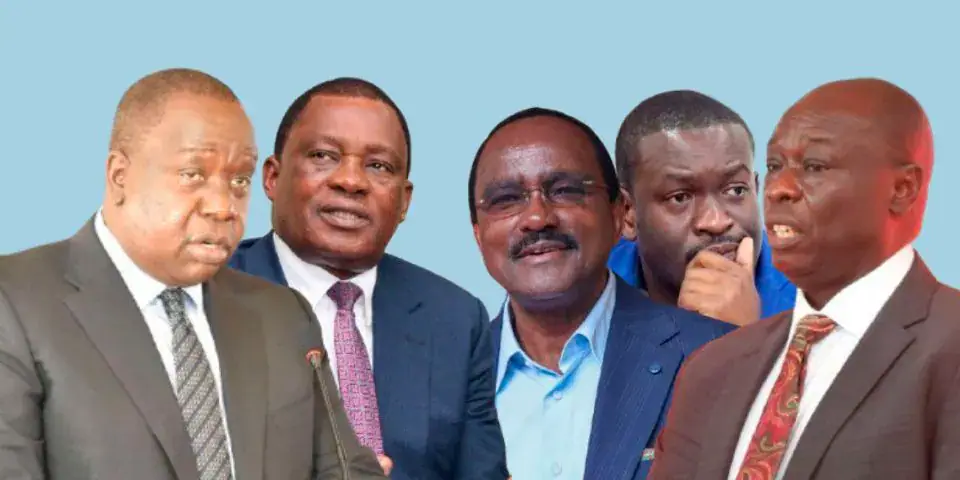
Kenyan opposition leaders are facing significant challenges as they attempt to unite against President William Ruto in the 2027 general elections. Despite their rhetoric about unity and discussions on finding a single presidential candidate, the leaders are grappling with questions about who will be given the ticket, who will step down, and how they will share power if they succeed. This has sparked tensions and uncertainties within the opposition.
A recent TIFA research report has added pressure to these discussions, revealing that 43% of respondents view Deputy President Rigathi Gachagua as the biggest obstacle to opposition unity. President Ruto follows with 15%, while Edwin Sifuna has 7%, and Kalonzo Musyoka has 6%. Other leaders, including Dr. Fred Matiang'i and Babu Owino, each garnered 4%, while former President Uhuru Kenyatta received 2%. These findings have intensified the debate within the opposition.
The opposition's internal struggles are further complicated by the emergence of a leadership crisis within the Linda Mwananchi movement. Babu Owino recently disclosed that there were prior agreements on how he and Sifuna would collaborate politically, but these plans changed. Owino stated that they had agreed Sifuna would be the presidential candidate while he led the new party, but the plan was altered. This revelation has exposed underlying tensions within the opposition.
Sifuna has also urged his supporters to remain committed to him, asking if they would stand by him until the end. Gachagua faces a more significant challenge due to a pending court case regarding his removal from office. His appeal is ongoing after the High Court declined to nullify the Senate's decision. Meanwhile, other politicians from the Mount Kenya region, including Ndindi Nyoro, Martha Karua, and Jimi Wanjigi, are strengthening their political positions.
In an interview with Inooro TV on November 1, Gachagua stated that if Ruto is re-elected, he might leave Kenya for the United States, where he owns a house. He suggested that the divisions within the Mount Kenya region could help Ruto secure another term and leave his critics in a difficult position. Kalonzo Musyoka also faces a tough decision on whether to insist on contesting for the presidency or support another candidate.
Analyst Geoffrey Mboya notes that Kalonzo, at 72 years old, has reason to carefully consider his decision. According to TIFA, Kalonzo enjoys 80% support in the Ukambani region, compared to Sifuna's 8%. Matiang'i must also evaluate his position in the complex landscape dominated by large political networks. Karua, on the other hand, wants a transparent and fair process for selecting a candidate and refuses to be a running mate to another candidate.
The tensions within the opposition are also reflected in statements from their allies. Wiper party chairman John Chamia warned that Kalonzo might contest for the presidency independently if he is not given the opposition ticket. Gachagua has expressed his willingness to support whoever is chosen as the candidate but has asked other aspirants to make similar commitments. The opposition's ability to present a united front against Ruto in the 2027 elections remains uncertain.
Key points
- The opposition's internal struggles and leadership crisis pose significant challenges to their ability to unite against President Ruto in the 2027 elections.
- A recent TIFA report revealed that 43% of respondents view Gachagua as the biggest obstacle to opposition unity.
- The opposition leaders must agree on a process for selecting a presidential candidate and power-sharing arrangements to present a united front against Ruto.
Reporting sources
- Kinachowakosesha usingizi vinara wa upinzani wakikabili Ruto 2027 · taifaleo.nation.co.ke