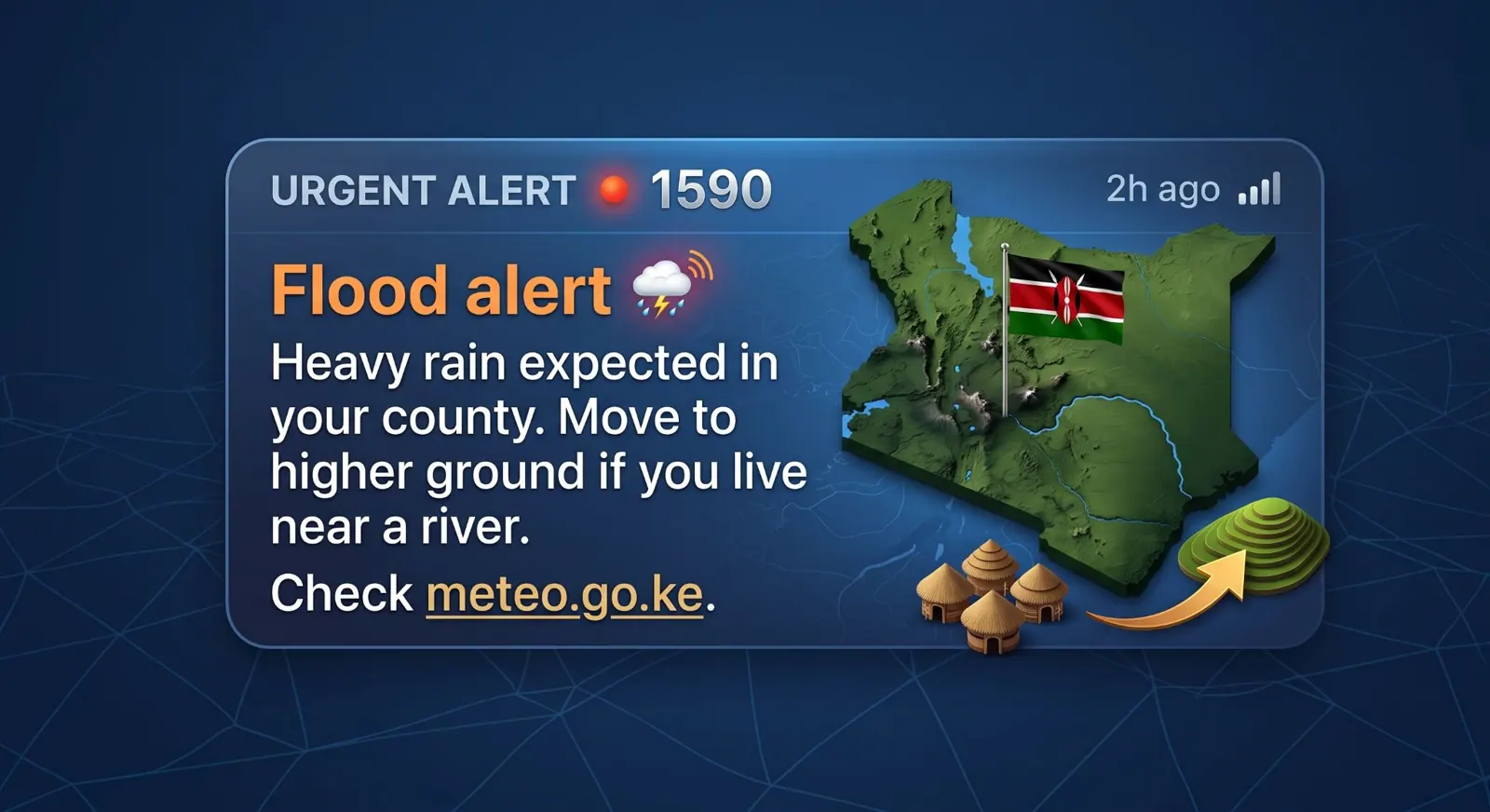
The Communications Authority of Kenya has mandated that mobile operators Safaricom, Airtel, Telkom, and Jamii Telecommunications deliver government-authorized emergency alerts to every active subscriber. These alerts will be sent via short code 1590 and may override Do Not Disturb settings. The messages will warn of El Niño-related rains expected within weeks and could be a drill, a general advisory, or an urgent instruction to move to safety.
The World Meteorological Organization confirms that El Niño is firmly established and likely to intensify by the end of 2026. The Kenya Meteorological Service Authority forecasts above-average rainfall across most of the country. Government spokesperson Charles Owino estimates a 90% chance of above-average or very high rainfall, although officials caution that not every county will experience flooding.
Residents in ten priority counties – Tana River, Garissa, Kisumu, Busia, Nakuru, Mombasa, Kilifi, Wajir, Mandera, and Turkana – are urged to prepare go-bags with essential items. These items include water, essential medicines, waterproofed documents, a torch, and a charged power bank. Acting Principal Secretary Caroline Karugu of the State Department for Arid and Semi-Arid Lands has called on people living in flood-prone and landslide-susceptible areas to relocate immediately.
A national flood-readiness assessment puts Kenya at 54% preparedness, noting that 18 counties and 5,660 health facilities lie in at-risk zones. However, funding gaps remain a major weakness. The 2026/27 budget lacks a dedicated line for El Niño response, and US Red Cross contributions have fallen by about 40%. The World Bank’s KES 51.8 billion facility will also need to cover Ebola and energy risks, limiting resources for flood mitigation.
The Auditor General’s review of the 2024 floods highlighted gaps in early warning and evacuation, pillars that this year’s plan seeks to strengthen. Challenges persist, such as debris still blocking Nairobi drains and uneven county-level implementation. Officials stress that successful evacuation depends on open, stocked centres and pre-agreed family plans that specify destinations, routes, and caretakers for children and the elderly.
The government has identified the need for improved preparedness and evacuation measures. With the expected above-average rainfall, residents are advised to take necessary precautions to ensure their safety. The national flood-readiness assessment has identified areas of weakness, and efforts are being made to address these gaps.
As Kenya prepares for the expected El Niño-related rains, residents are urged to remain vigilant and take necessary precautions. The government has put in place measures to alert residents of potential floods and landslides, and residents are advised to follow evacuation instructions. By working together, Kenya can mitigate the effects of El Niño and ensure the safety of its citizens.
Key points
- The Communications Authority has mandated mobile operators to send El Niño alerts to all subscribers via short code 1590.
- Kenya is expected to experience above-average rainfall due to El Niño, with a 90% chance of above-average or very high rainfall.
- Residents in priority counties are urged to prepare go-bags and relocate to safer areas if necessary.