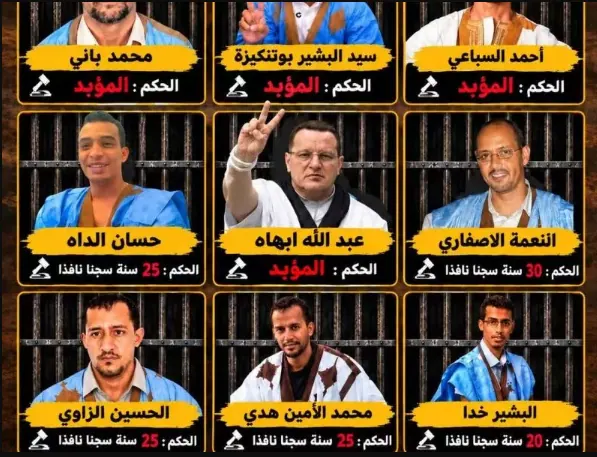
A group of nine Sahrawi civilians, part of the Akdim Izig group, have been on an open-ended hunger strike since September 23, 2026, to protest their continued detention in various Moroccan prisons. The prisoners, held in Ait Melloul 2, Tifelt 2, and Kenitra prisons, are demanding respect for international humanitarian law and the implementation of decisions from the Working Group on Arbitrary Detention and the Committee against Torture. Their detention has been marked by alleged mistreatment and poor living conditions.
The prisoners' families and the Association for the Protection of Sahrawi Prisoners in Moroccan Prisons have raised concerns about the lack of information on the prisoners' whereabouts and their deteriorating health. Some prisoners have been transferred to different prisons without prior notice, leaving their families unaware of their locations for extended periods. For example, prisoner Naama Asfari was transferred to the Oudaya prison in Marrakech on September 23, and his family was only informed of his whereabouts on September 28.
The prisoners' health has been deteriorating, with some requiring medical attention. On September 25, prisoner Mohamed Bani was transferred to a prison infirmary in Ait Melloul 2 due to his worsening health, forcing him to end his hunger strike. Others, such as Hassan Dah, have reportedly lost significant weight and continue to participate in the hunger strike despite their poor health. The Association has also reported allegations of physical abuse and mistreatment during transfers.
The prisoners' families have faced difficulties in visiting them, with some being denied access or traveling long distances only to be turned away. The Association has documented multiple instances of alleged human rights abuses, including isolation, arbitrary transfers, and inadequate medical care. These practices are said to contravene international agreements, such as the UN Standard Minimum Rules for the Treatment of Prisoners and the Convention against Torture.
The Association for the Protection of Sahrawi Prisoners in Moroccan Prisons has called on the international community to intervene and protect the lives of the hunger strikers. They have urged the UN Secretary-General to pressure Morocco to respect its international obligations and provide adequate medical care to the prisoners. The Association has also demanded an investigation into allegations of abuse and mistreatment during detention and transfers.
The situation has sparked concerns about the treatment of Sahrawi prisoners in Morocco and the enforcement of international humanitarian law. The prisoners' detention has been a point of contention between Morocco and the Sahrawi community, with allegations of human rights abuses and mistreatment. The international community has been urged to take action to address the situation and ensure the prisoners' rights are respected.
The Association's demands include the immediate disclosure of the prisoners' whereabouts, the provision of independent medical care, and the transfer of the prisoners to prisons within the Western Sahara region. They have also called for an end to isolation and retaliatory measures, as well as the protection of the prisoners' rights to communicate with their families and lawyers.
Key points
- Sahrawi prisoners in Morocco have gone on hunger strike to protest their detention and alleged mistreatment.
- The prisoners' health has been deteriorating, with some requiring medical attention.
- The Association for the Protection of Sahrawi Prisoners in Moroccan Prisons has called on the international community to intervene and protect the lives of the hunger strikers.