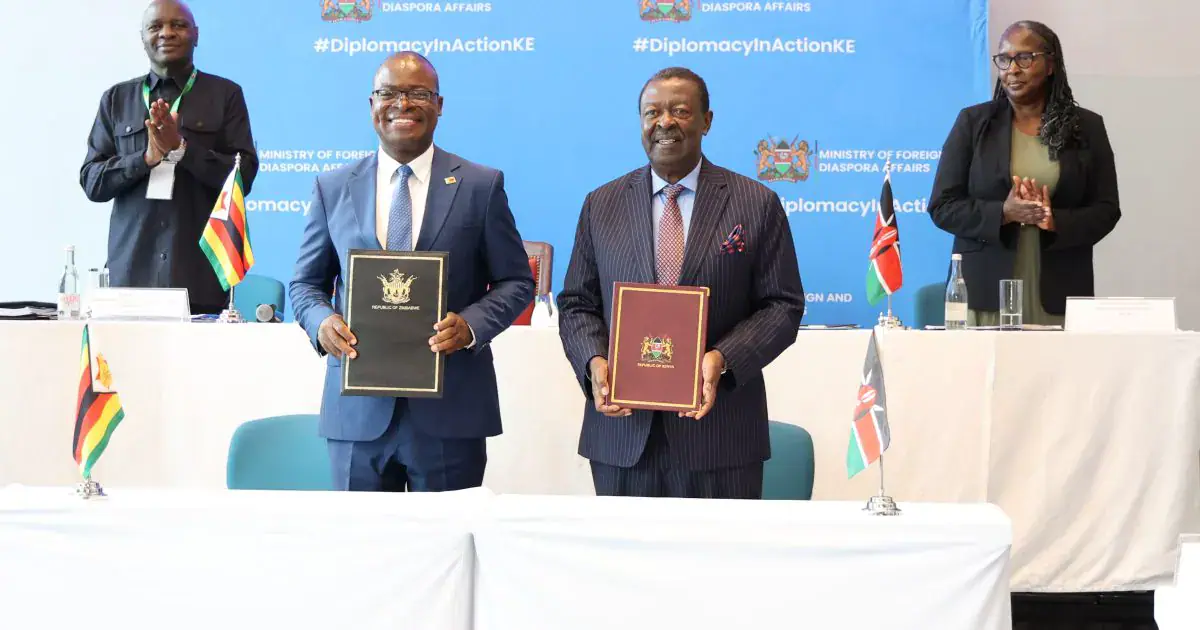
Kenya and Zimbabwe are seeking to deepen bilateral trade and investment, with a focus on strengthening economic cooperation and removing trade barriers. The two countries have agreed to accelerate the implementation of joint agreements ahead of the inaugural session of the Kenya-Zimbabwe Binational Commission. This commitment was made during the Ministerial Session of the Fifth Kenya-Zimbabwe Joint Permanent Commission for Cooperation in Nairobi.
Officials from both countries reviewed progress in bilateral cooperation and agreed on priority areas to advance their strategic partnership. Prime Cabinet Secretary and Cabinet Secretary for Foreign and Diaspora Affairs Musalia Mudavadi emphasized that the two countries must translate their longstanding political goodwill into tangible economic benefits for their citizens. He noted that bilateral trade remained below its potential, with total trade standing at USD 57.6 million in 2025.
Mudavadi stated that the two countries had set a target of achieving USD 70 million in annual trade by 2026. He added that improved trade logistics, increased private sector participation, and strategic promotion of products would be critical in attaining the target. Mudavadi called for a structured, predictable, and private sector-driven approach to trade, with particular attention to micro, small, and medium enterprises and manufacturers.
Kenya and Zimbabwe have signed 17 bilateral agreements covering sectors including defence, agriculture, health, investment promotion, tourism, sports, transport, public service capacity development, and education. An additional nine legal instruments will be presented for consideration and signing during the inaugural Binational Commission scheduled for November 27, 2026, in Nairobi. The commission will be co-chaired by President William Ruto and his Zimbabwean counterpart Emmerson Mnangagwa.
The new framework will provide an opportunity for the two countries to integrate their economies, leverage their respective strengths, and strengthen cooperation amid changing global geopolitical dynamics. Mudavadi also called for greater utilization of regional integration frameworks, including the Common Market for Eastern and Southern Africa and the African Continental Free Trade Area, to expand market access.
Zimbabwe's Minister for Foreign Affairs and International Trade, Prof. Amon Murwira, urged the two countries to leverage their complementary economic strengths to expand trade, investment, and industrial development. He stressed that Zimbabwe was keen to transform the strong political relations between the two countries into increased commercial exchanges and joint investment projects.
The two countries reaffirmed their commitment to strengthening cooperation in regional and multilateral institutions, particularly the African Union and the United Nations. Mudavadi welcomed Zimbabwe's election as a non-permanent member of the United Nations Security Council for the 2027-2028 term and pledged Kenya's support through experience-sharing and closer coordination.
Key points
- The two countries aim to increase bilateral trade to USD 70 million by 2026.
Reporting sources
- Kenya, Zimbabwe move to deepen trade ties · Kenya News Agency