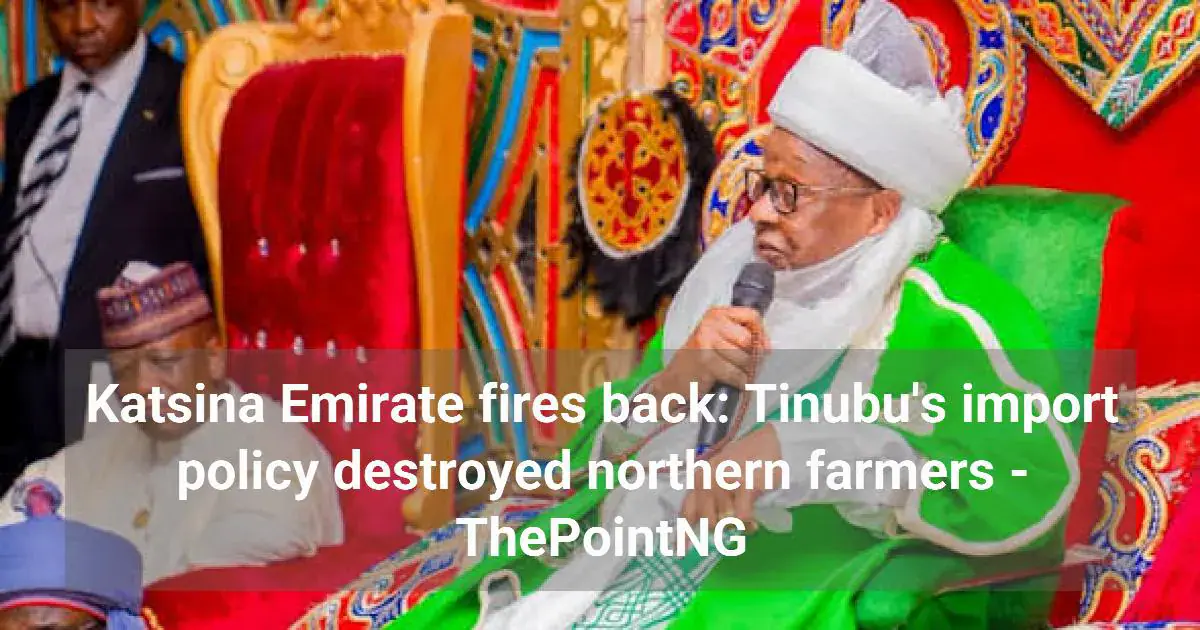
Aliyu Mohammed Kurfi, a prominent defender of the Katsina Emirate, has criticized the Federal Government's food-import policy, stating it has devastated the region's agricultural economy. Kurfi argued that the Tinubu administration's 150-day duty-free import window for selected food commodities has made it harder for local farmers to sell their crops at profitable prices. This policy has compounded the misery of farmers who were already struggling with insecurity and high production costs.
The controversy began when the Emir of Katsina spoke out about hunger, insecurity, and the welfare of his people. Kurfi insisted that the traditional institution has a duty to speak out, regardless of which political party controls the government. He accused critics of applying double standards by questioning the Emir's decision to speak publicly about present economic difficulties while overlooking the palace's earlier interventions over insecurity during the administration of former President Muhammadu Buhari.
Kurfi cited the case of a rice farmer in Kurfi who borrowed N400,000 to cultivate his farm in May 2024, only to encounter a sharply weakened market when he harvested in October. The price of paddy rice fell from N650,000 per tonne to N350,000, leaving the farmer unable to repay his loan. Kurfi also mentioned maize farmers in Batsari and wheat farmers in Bakori, arguing that importing competing commodities while local farmers were trying to recover from insecurity and rising production costs threatened their ability to earn a living.
The policy, introduced in July 2024, aimed to increase food supply and reduce prices. However, Kurfi argued that it placed additional pressure on local farmers who were already struggling with insecurity, high production costs, and limited access to their farms. He maintained that the policy created a double burden for Northern farmers: banditry restricted cultivation, while cheap imports undermined the commercial value of the crops they managed to produce.
Kurfi challenged defenders of the administration's economic reforms to demonstrate how the measures had improved the financial fortunes of farmers in Katsina and other Northern states. He launched a forceful defence of the Emir of Katsina against allegations that the palace had remained silent during the eight-year Buhari administration but had become vocal under President Bola Tinubu. Kurfi cited two incidents, including an alleged public intervention on May 6, 2019, when the Emir reportedly appealed to Buhari over the killings of farmers and growing insecurity in Katsina.
Kurfi also mentioned the cancellation of the Sallah Durbar in May 2021, which he described as a major cultural and economic sacrifice intended to draw attention to the worsening security situation. He argued that cancelling one of the emirate's most significant traditional celebrations was a public demonstration of concern, not evidence of silence. Kurfi maintained that the palace had consistently spoken out under successive administrations and would continue to defend the interests of Katsina residents.
The dispute has reopened questions about the responsibility of political authorities and traditional institutions in tackling banditry in Katsina State. Kurfi insisted that the Emirate neither commands the military nor controls the police, the Department of State Services, or other security agencies. He questioned why the traditional institution should bear the blame for the activities of armed groups when the Buhari administration had control over the military, police, and intelligence agencies.
Key points
- The Katsina Emirate's defender, Aliyu Mohammed Kurfi, criticizes the Federal Government's food-import policy, citing harm to local farmers.
- Kurfi argues that the policy has undermined the profitability of farming in the region, compounding the misery of farmers struggling with insecurity and high production costs.
- The controversy has reopened questions about the responsibility of political authorities and traditional institutions in tackling banditry in Katsina State.