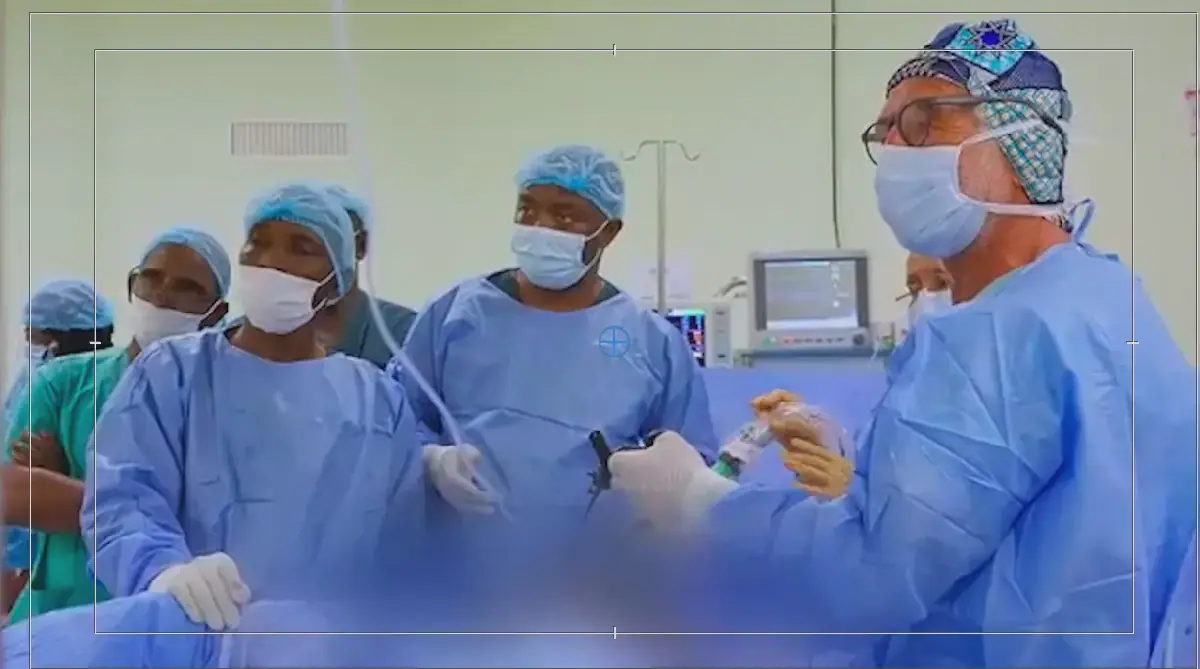
The Centre Hospitalier Universitaire (CHU) Donka in Guinea is hosting its third medical mission from France, focusing on coelioscopy training and patient care. This collaborative effort aims to enhance the practical skills of Guinean surgeons while treating patients with various abdominal and gynecological conditions. The mission builds on two previous successful collaborations, demonstrating the growing interest in this surgical technique.
The number of patients benefiting from these missions has steadily increased, from 6 in the first mission to 13 in the second and 23 in the third. According to Professor Fodé Lansana Camara, head of the visceral surgery department, this growth reflects the rising popularity of coelioscopy. The conditions being treated include hernias, appendicitis, ovarian cysts, tubal obstructions, and certain gallbladder disorders.
This third mission prioritizes refining technical skills, with a focus on progressive transfer of competencies. Previous missions have enabled Guinean surgeons to improve their coelioscopy skills and perform certain procedures autonomously. Professor Camara acknowledges the significant progress made, citing examples such as open-coelioscopy and herniorraphy.
French surgeon Jean-Philippe Combier praises the motivation and collaboration of Guinean practitioners, expressing optimism about their ability to gain autonomy in coelioscopy with continued support. He suggests organizing two missions per year to further enhance local competencies. The long-term goal is for Guinean surgeons to master coelioscopy and practice it independently.
The CHU Donka administration welcomes the ongoing medical cooperation, with Mamadou Aliou Bah, Interim General Administrator, emphasizing the importance of developing surgical practices. He notes that coelioscopy reduces hospitalization time and avoids large incisions, aligning with the hospital's modernization strategy and capacity-building goals for local surgeons.
Coelioscopy offers several benefits, including shorter hospital stays and minimal scarring. Patients can return home just 24 hours after surgery, and the technique helps prevent large incisions. The CHU Donka aims to integrate this advanced surgical method into its services, enhancing patient care and reducing reliance on external medical facilities.
The CHU Donka and its French partners are committed to sustaining this medical collaboration, with plans for future missions to consolidate progress and expand coelioscopy services. The partnership supports Guinea's healthcare development, focusing on capacity building and improving surgical care.
Key points
- The third medical mission at CHU Donka aims to enhance coelioscopy skills and patient care.
- The number of patients benefiting from coelioscopy missions has increased significantly.
- The partnership plans to organize future missions to support sustained progress in coelioscopy.