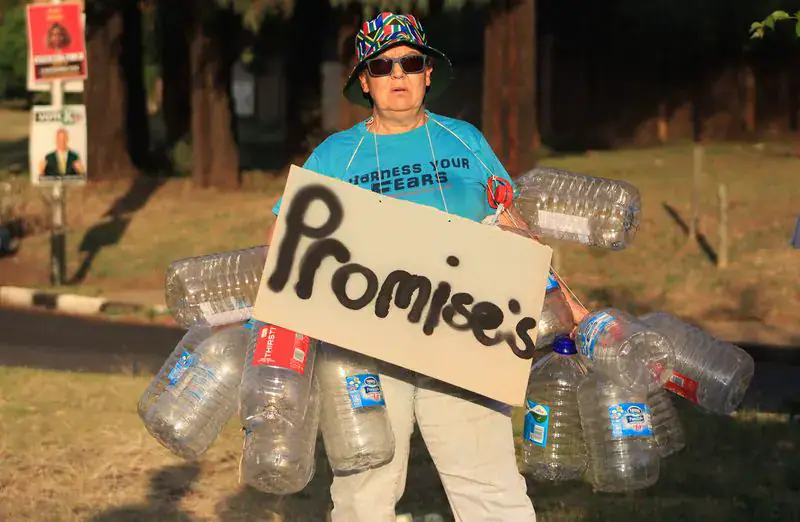
Residents in Kensington, Johannesburg, took to the streets on October 29 to protest water cuts, joining a growing wave of demonstrations across the city. The protests come ahead of the November local elections, with residents demanding urgent repairs to distribution networks and restoration timelines. Neil Holland, a 66-year-old hairdresser, has seen his business suffer significantly since the water stopped, with customers turned away and revenue plummeting.
The water shortages in Joburg's eastern suburbs can be traced to the Alexander Park Reservoir, which has remained on bypass for months due to postponed repairs. Despite funds being earmarked for its maintenance, the facility's storage buffer is offline, leaving the local grid running directly off incoming bulk mains. When Rand Water restricts bulk supply, there is no stored pressure left to push water uphill into higher-lying streets, according to independent water and sanitation expert Richard Holden.
Residents like Wilhelmina Martin, who suffers from multiple sclerosis and myasthenia gravis, are severely impacted by the water outages. Martin, 53, relies on her husband to fill buckets and assist with daily tasks, as navigating an environment without water is extremely challenging. She begged for government intervention, questioning whether her community is not important enough to deserve access to water.
The protests are not limited to Kensington, with residents in Lenasia, Melville, and Parktown also taking to the streets. In Parktown, Sharol Stevens, a resident of almost 50 years, has attended multiple protests, highlighting the irregular and unreliable water flow. Stevens emphasized the lack of effective communication from Joburg Water, despite a recent meter installation to measure water supply.
The mounting frustrations are set to culminate on November 2, in a unified demonstration to demand immediate accountability, water relief, and urgent intervention for the city's crumbling water infrastructure. Civil society groups, including WaterCAN, will gather at Joburg Water's headquarters in Newtown to demand action. Nomsa Daela, a citizen science and training coordinator, emphasized the disproportionate impact of water outages on elderly people.
Daela criticized Joburg Water for failing to warn residents in advance about brief supply windows, adding that alternative means for people to access water should be provided. The protests highlight the need for urgent repairs to the city's water infrastructure and effective communication with residents. As the local elections approach, residents are demanding action from their government.
The water crisis in Johannesburg has been ongoing since February, with large parts of the city affected by a multi-system failure. Despite promises of change, residents continue to face unreliable water supply, with some areas experiencing zero water for extended periods. The protests demonstrate the growing frustration among residents, who are demanding a resolution to the crisis.
Key points
- Residents in Johannesburg are protesting water cuts, citing decaying infrastructure and municipal management failures.
- The protests come ahead of the November local elections, with residents demanding urgent repairs to distribution networks and restoration timelines.
- The water crisis in Johannesburg has been ongoing since February, with large parts of the city affected by a multi-system failure.